
Pokémon Is OSR
Long before I rolled a twenty-sided die to simulate the swing of a sword, I experienced the thrill of a critical hit. I’ve been ambushed by more goblins than you could shake a stick at, but my random encounter was a tiny bird. I had memorized all the details of dragons and other monsters without ever having read a manual on the subject. I never blinked at the mention of hit points. Before I was a teenager pretending to be an elf, I was a 5-year-old pretending to be a 10-year-old.
Psst, if you like Pokémon or the OSR, you may be interested in Into the Oddish and Vileplume Mountain, which you can currently pre-order from this very website!
For many in the OSR, particularly its first heydays, there was a whole cohort of 80s kids who yearned for their earliest memories of role-playing games. Those were never my reference points. My earliest experiences of the hobby consisted of running 3rd edition D&D adventures (tinged by their own nostalgia) during the interregnum before the dawn of the 5th. But like the bulk of people experiencing D&Dalikes for the first time, I was no stranger to the conventions. Not just the conventions of fantasy fiction–sure, I have heard of elves and dwarves and wasn’t imagining them to be of the Keebler or Snow White variety, respectively–but the conventions of the game itself. Of equipping your character and turn-based combat and casting spells and fending off random encounters. A thousand video games, themselves borrowing, directly or indirectly, from Dungeons and Dragons, had inculcated in me all that I needed to know. I took to the game like a fish to water because the water had always been around me.
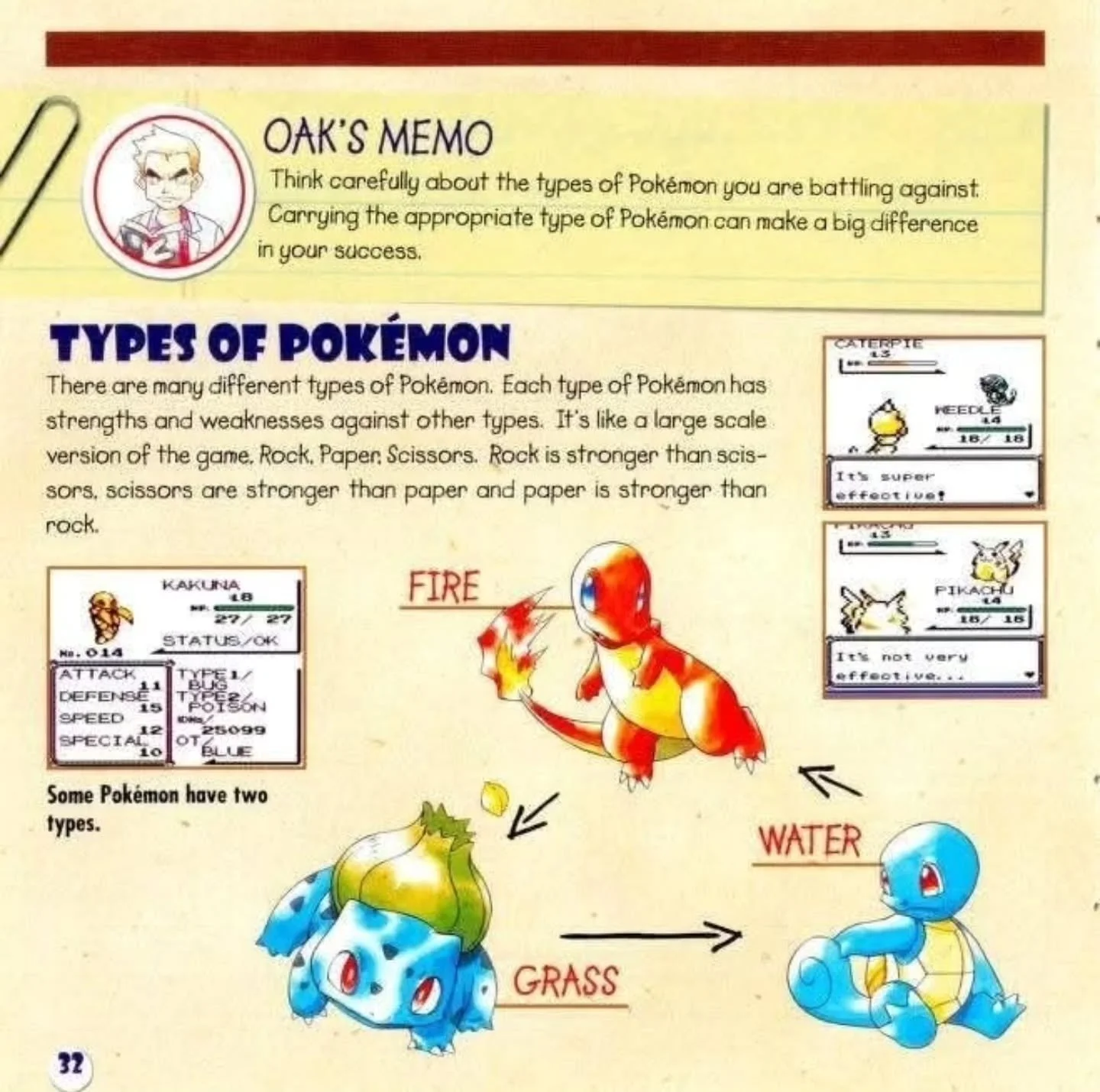
But my first experience with all that was pre-literate. On February 27, 1996, Pokémon was released. But, like, in Japan. It wasn’t until I was almost 5 that it reached me by means of a borrowed Game Boy from older cousins (how many older cousins, specifically, are responsible for such things? I’d venture a high guess). I could not read yet, but I figured it out. Eventually I could recognize certain words and could intuit what they did by the rudimentary graphics and their impact on the health bars of my opponents. There were still things I didn’t understand–I assumed (and frankly, it’s a habit I haven’t broken) that you need to tap “A” as fast as you can when trying to catch a Pokémon. But it was this red cartridge that was my introduction to D&D, albeit indirectly. It wasn’t until much later that I realized how much it has influenced my lasting predilection for the so-called “old school” playstyle of said genre of tabletop games.
I am not exactly breaking new ground here. It is well-established that Dungeons & Dragons was the primary inspiration for (aside from frankly the entirety of video games, to greater or lesser degrees) Ultima and Wizardry (the latter of which was a party-based RPG, like Pokémon), which in turn became a core part of Japanese RPGs and Japanese fantasy to this day. It is no coincidence that the world of Dungeon Meshi (aka Delicious in Dungeon) resembles that of bog-standard D&D. Even though Pokémon (the cards in particular) are cited as a reason for the “The Winter Era of Tabletop RPGs” in Japan, it also carried the strands of D&DNA from its JRPG predecessors.
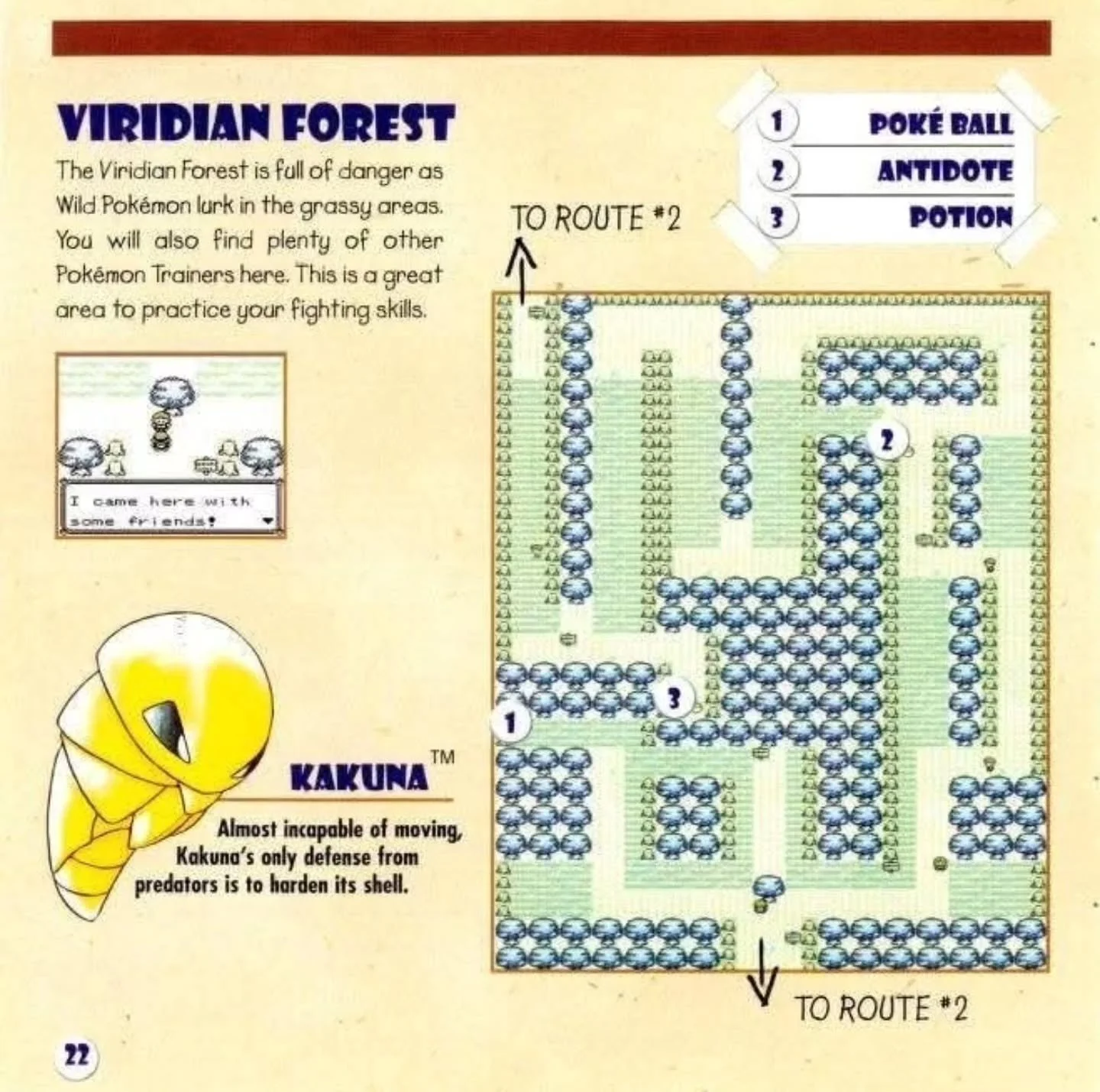
My first “dungeon crawl” was arguably Viridian Forest. Or Mt. Moon if your definition of a dungeon excludes those above-ground (or if you find Viridian Forest insufficiently Jaquaysed). Were these good dungeons? Well, referring to Goblin Punch’s checklist on the subject, they had things to steal (left behind items and prize money from vanquished trainers), it had plenty of things to kill (okay, I guess the Pokémon just pass out, but we all know what really happens when I hit that Caterpie with my Charmander’s ember attack), something to kill you (maybe you don’t die; you just pass out and wake up at the hospital. Unless it’s a Nuzlocke run, but more on that later), different paths (although the paths and dead-ends in Viridian Forest were much simpler than later dungeons in the game), someone to talk to (all the rival trainers are quite chatty, even if the player character were stoic and silent), something to experiment with (less true with these than with the later Hidden-Machine puzzle focused dungeons, but the rock-paper-scissors gameplay itself and new monsters along every corner was something to experiment with back in the day when I didn’t have all the details memorized or easily searchable online. I discovered type advantages and disadvantages through trial and error!), and something players probably won’t find (less true for me now that I have every route committed to memory, but can I be sure 5-year-old me found that rare candy in Mt. Moon? At the very least, there was no way to walk away from the dungeon with both fossils. Not to mention rare wild Pokémon. My little mind was well and truly blown when after bug after bug I ran into a wild Pikachu in Viridian Forest, ripe for the capturing). Yeah, these were good dungeons.
What made the dungeons feel, in hindsight, especially like a dungeon crawl of yore were the random encounters. Was it always fun to run into a Zubat that refused to leave you alone when you tried to run away? Not by itself, but it was part of the challenge of the game and the challenge made it fun. It also provided agency: you could spend your money on repels to avoid having so many random encounters, but that’s a trade off. Now you have less money to blow at the casino later. But random encounters in Pokémon were more than just opportunities to fight; each was also an opportunity at friendship. Remember the elation I described above at finding a wild Pikachu? It wasn’t because I wanted to exterminate the little bastard as I had with so many Weedles before it. It was because I wanted to catch it and add it to my team. Each throw of a Poké Ball is essentially rolling a reaction roll. Is this Pokémon going to remain hostile to me, or are we about to become best friends? This video from Design Doc does a good job of describing just how well suited the random encounter, part of the aforementioned D&DNA of Pokémon, works for the original Pokémon games (although it also contains Mt. Moon slander). The Matthew Buscemi blog also comes to the defense of the much-aligned random encounter in the context of JRPGs.
What defines Pokémon even more than its rock-paper-scissors elemental battle system or its 151 (now 1,025) monsters is the fact that at any given time you can only have six monsters with you. These games also taught me the importance of party management before anyone ever asked me to play a cleric because we didn’t have a healer in the party (fuck you; you be the cleric!). I don’t play many class-based games these days, but even then in the adventuring party based games of which the OSR is fond, you tend to fill party roles. Maybe you’re the beefy bruiser who can take a punch and give one, or maybe you’re the smarty pants with the answer to any question or spells for the questions without answers, or you might be the suave party “face”, talking your way out of, and just as often, into trouble. Pokémon instilled these basic instincts in me as soon as its first gym. My Charmander wiped the floor with all the birds and bugs I had come across but was blown out at Brock’s Rock-type gym. I had to grow my roster (and the aforementioned Pikachu also was not particularly helpful here) if I was going to get past that on anything other than just brute-forcing it with an overleveled Charmeleon (which honestly, is probably what I did). But even then you would need more than just your overleveled starter if you were going to progress once Hidden Machines came into play. In Pokémon, it isn’t so much that you need a healer as it is that you need some Pokémon that knows Cut (and, more importantly, where it isn’t a pain in the ass that one of their 4 precious moves are dedicated to Cut).
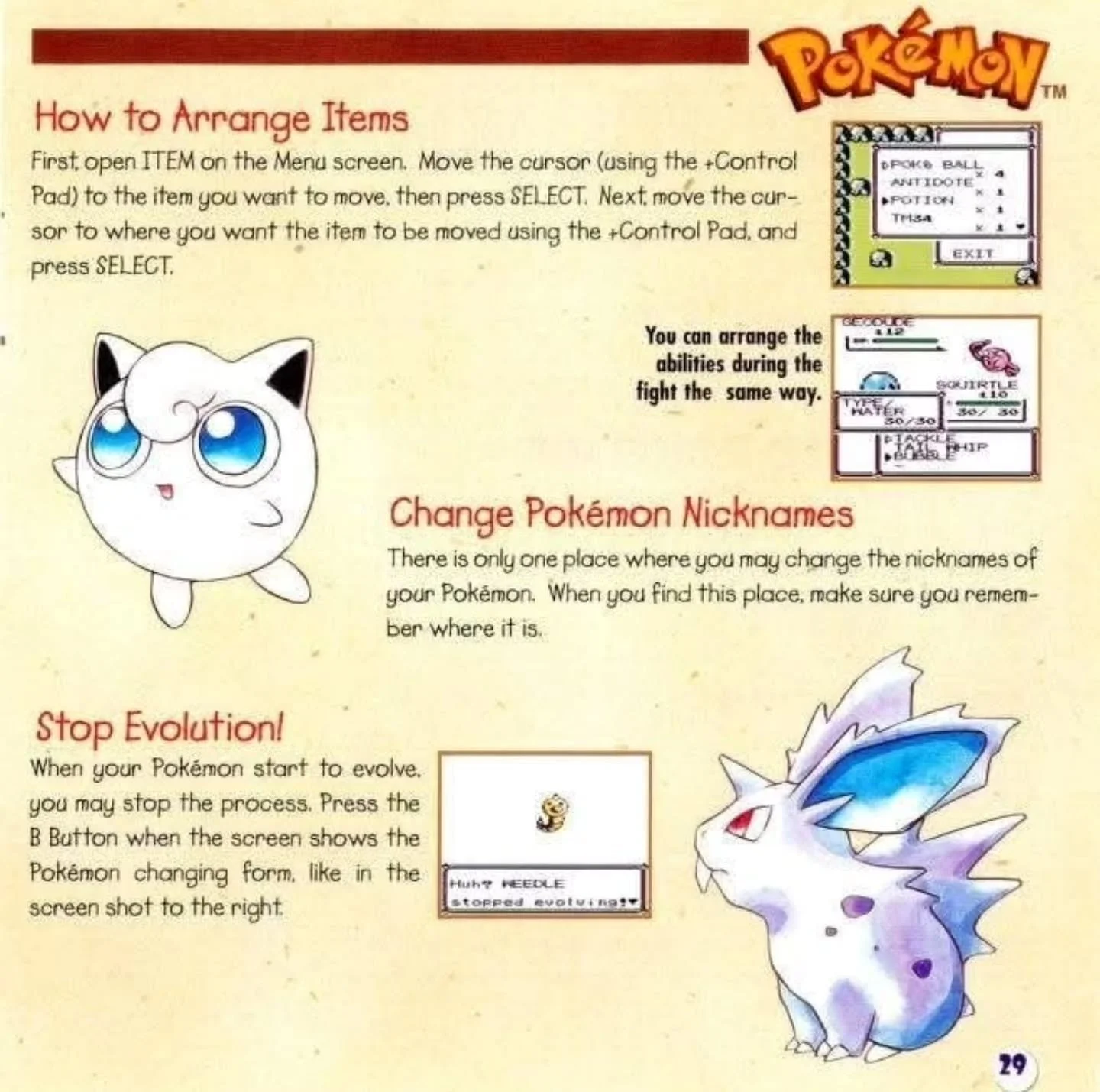
With six Pokémon in your party, it means you have access to, at most, 24 moves. This is because each Pokémon can only know 4 moves at a time. And in the early games, you could only carry up to 20 types of items in your bag. While the item limit has dropped out in modern iterations, I think it and the limit on number of Pokémon and limit on those Pokémon’s moves are all fun, challenging aspects to the game. When you are about to face off against a gym, you need to make sure you have the right Pokémon at your disposal. When you are about to crawl through one of Pokémon’s aforementioned dungeons, you need to balance how much stuff you are carrying in your bag. Too little and you may run out of the precious potions, antidotes and other items that you need to keep your Pokémon healthy enough to fight. Too many and when you come across that rare candy laying on the dungeon floor, you may get the “Your bag is full” message. Through its constraints, Pokémon is making you make choices and seeing how those choices play out and letting that inform your future choices is part of the enjoyable challenge of the game. We could imagine a Pokémon variant where there are none of these limits. You have as many Pokémon as you’ve caught available to you in every battle, each knows every move it has ever been able to learn, and you have unlimited item slots. My first instinct is that obviously the strength and versatility of enemies would have to be increased drastically to keep up with this change, but ultimately it would be a major slog. Even just having so many options every turn is an overwhelming amount of choice, like ordering off a Cheesecake Factory menu. If you are familiar with the OSR playstyle or many of its game systems, the idea that inventory management produces more, not less, meaningful choices and faster gameplay is a given. Pokémon understood these truths long before they were written down in any blog. Limits are an important implicit part of the ICI doctrine’s magic.
But even Pokémon’s game-imposed limits do not go far enough for me. In 2010, a procrastinating student invented a new way to play the game: the Nuzlocke. If you’re interested enough in Pokémon to have gotten to the 9th paragraph of this post, you probably already know what that is, but for those unacquainted, it is basically the totally self-imposed “hardcore mode” for Pokémon. First, it limits which Pokémon you could catch to only the first Pokémon you find in each new area. Second, it adds lethality to Pokémon. In the base game, there is universal healthcare. Your Pokémon runs out of hit points? No big deal, just bring them to one of the many hospitals dotting the landscape and they’ll be good as new. All your Pokémon run out of hit points? You may lose some money and have to retrace your steps from the last hospital you had visited, but all your Pokémon are patched back up. Not so in a Nuzlocke run. When a Pokémon faints, you must release it. It’s dead. Per the concept’s creator, it had an unintended effect: “The results were unexpected; rather than simply increasing the difficulty, these rules caused him to care for his monster companions more than ever before. He found new appreciation for Pokemon he would have previously never bothered to capture, and he worried deeply for his team, knowing any knockout would mean goodbye.”
The popularity of the Nuzlocke run in Pokémon ties back to the OSR playstyle in two ways. The obvious is the introduction of lethality. See, for instance, Gus L. of All Dead Generations citing as a core design principle of his preferred playstyle that “[c]ombat should retain its lethality and function as the embodiment of risk”. The base version of Pokémon lacks this, but with a Nuzlocke, even that random Zubat encounter has the chance of permanently killing off a core member of your Pokémon adventuring party. For a game that targets children and that even a barely literate 5-year-old can play (although I didn’t beat it until I was 6), it adds more of a challenge to the game.
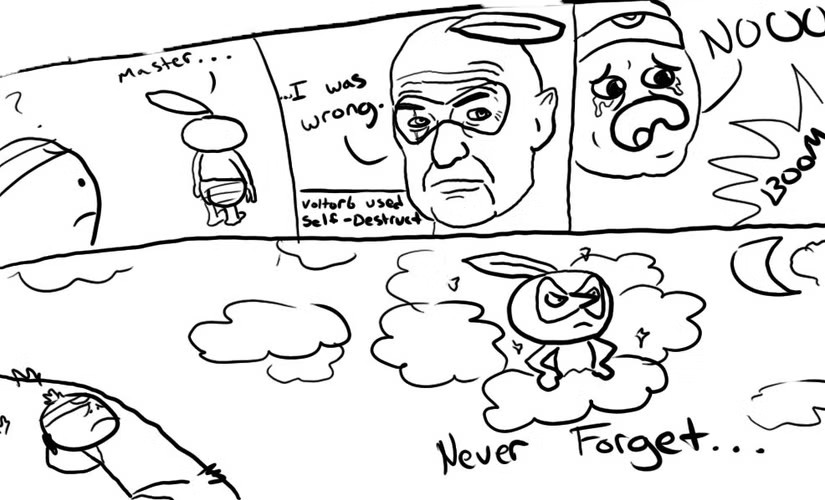
But the OSR is not merely grimdark lethality (in fact, the grimdark aspect never appealed overmuch to me; I’ve always been a whimsy- and gonzo-enjoyer). In contrast to the more recent developments in name-brand D&D and its more recent descendents, the OSR emphasizes character discovery over character creation. This is why rolling for stats randomly (3d6 down the line) produces a different gamefeel than if you are using point-buy to generate your stats. You aren’t building a character, customizing them like you would in the character creation screen of so many video games. You are instead discovering what this character is like through play. Nuzlocke causes you to do the same thing. In standard Pokémon, you get to try to catch ‘em all and pick and choose the right combination for your team, making sure you can cover any enemy elemental type combination. Not so with a Nuzlocke. It leans into the random encounter mechanic as a party-building mechanic. Now your team is randomized. You may not have an ideal party composition. You may even have duplicates on your team.
But Nuzlocke discovers an unintended peanut-butter & chocolate combination that is core to my enjoyment of OSR-style games. For the typical playstyle in 5e games and similar, you lovingly craft a character and that character is almost never meaningfully threatened with the possibility of permanent death. It is somewhat counter-intuitive, but as a player (and even as a referee), I have rarely grown as attached to those types of characters as I have the ones that were generated totally randomly and are always risking their life every time they sally forth for an adventure. It may be that the challenge of keeping such a character (typically unoptimized for dangers of the dungeons) alive draws you closer to them when they do survive. You learn to love and embrace their many flaws. The close calls with death make you appreciate this fragile being you’ve created in your mind and on your character sheet. If Pokémon is OSR, Nuzlocke is even more so.
I’ve been playing Pokémon my entire life and was an early adopter of the Nuzlocke challenge. I’d mastered both before I encountered D&D directly. This isn’t an unusual dynamic for gamers that didn’t get their start (or weren’t even alive) in the 70s and 80s. D&DNA is in almost every modern video game and tabletop game. The tropes, mechanical or fictional, that germinated from Dungeons and Dragons are likely experienced hundreds of times before a modern gamer ever reaches their source (if one could even consider 3e or 5e, the “source” and not playing OD&D itself, which even a sicko like myself has only done less than a handful of times). For me, Pokémon was my first taste of the recognizable flavors of D&D, and even not-then-invented OSR. Pokémon may not be precisely OSR, but the family resemblance is still uncanny.
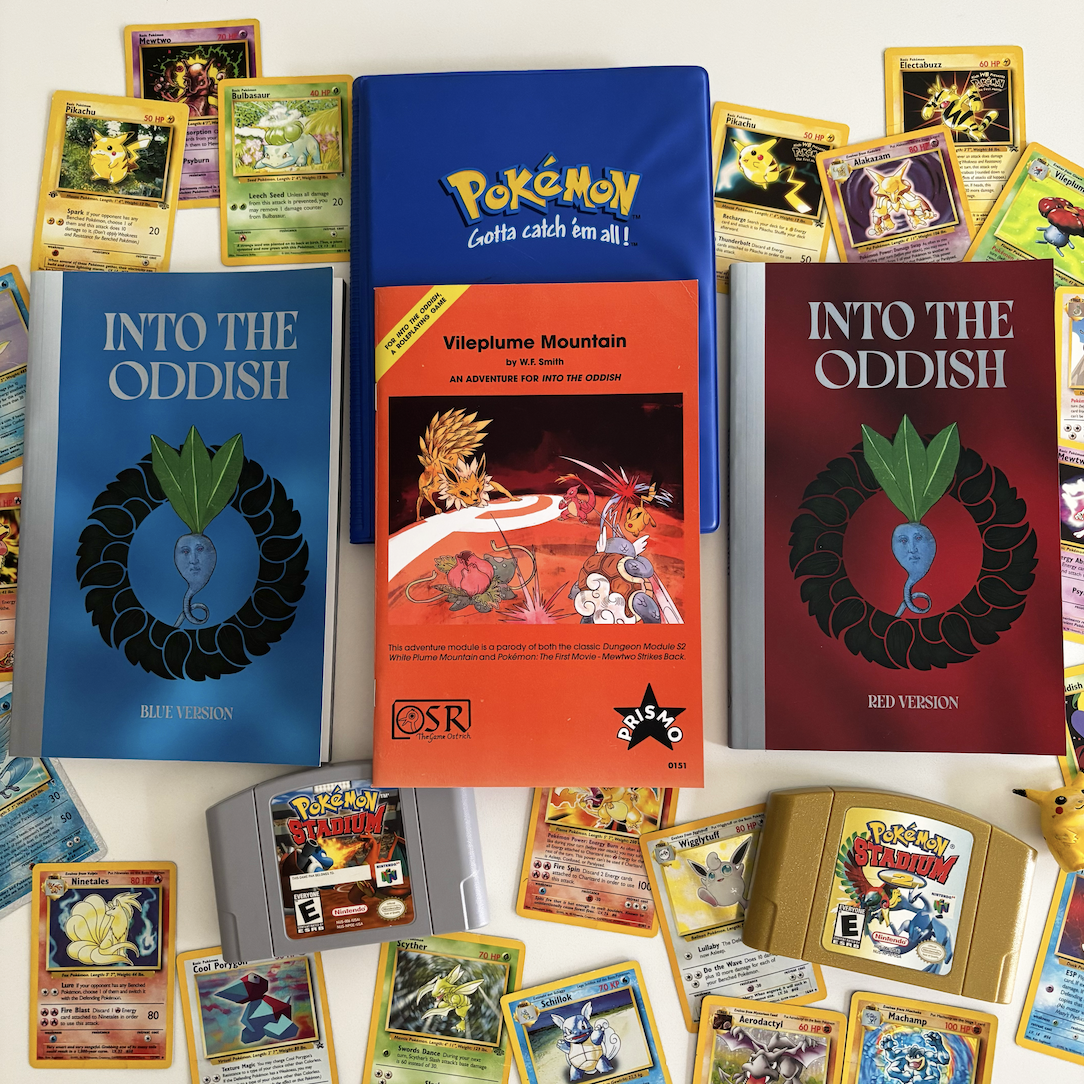
A tabletop roleplaying game where you play as pocket-sized monsters adventuring through the ruins of a Pokapocalyptic world
A world of dreams and adventures awaits!
Into the Ish is a parody of the classic rules-light game, Into the Odd, where you play as pocket-sized monsters instead of ordinary adventurers.
Into the Ish expands the core rules of Into the Odd to capture the genius of monsters fighting each other with elemental attacks. Each player takes on the role of a single monster in a party of adventurers traversing the Pokapocalyptic landscape after the mysterious disappearance of all humans. Search the world for rare Technique Machines, collect badges and evolve your monster.The Catch All Bundle is for Into the Ish completionists and includes Into the Ish (Red Version), Into the Ish (Blue Version) and the Vile Mountain adventure at the steepest discount.
What’s in This Bundle?
15 playable pocket-sized monsters with unique move sets and two evolutions each
Expanded Into the Odd-like rules covering elemental type effectiveness, moves that lower accuracy for auto-hit combat, and status effects like poison
Over 100 moves for your characters to learn and wield against your enemies
74 enemy monsters to challenge players at every stage of their journey (and compatible with other Into the Odd games, like Cairn)
Writing by W.F. Smith (Prismatic Wasteland), Character Sheet by Bruno Prosaiko, Front Cover Art (Vile Mountain only) by Sam Mameli (aka Skullboy), Back Cover and Interior Art (Vile Mountain only) by Hodag RPG (aka the Hodag), Layout by K.T. Nguyen (Barkeep on the Borderlands)
What You’ll Get?
Into the Ish (Blue Version): 86 pages, perfect-bound book, digest size (5.5” x 8.5”), full color cover and interior
Into the Ish (Red Version): 86 pages, perfect-bound book, digest size (5.5” x 8.5”), full color cover and interior
Vile Mountain: 36 pages, perfect-bound zine, digest size (5.5” x 8.5”), full color cover and black-and-white interior
The downloads: Hyperlinked PDFs of the core rules and adventure
When You’ll Get It:
Now! Pre-Orders have been fulfilled and these are shipped out as they’re ordered.