
All Along the Clocktower
When E.G. Gygax commanded that all must keep strict time records lest their play be meaningless, there wasn’t much guidance for exactly how strict time records should be kept, which was great. A gauntlet was thrown but with no prescribed method whereby said gauntlet could be picked back up, it led to a flourishing of time tracking methods across the medium. Of course, you could simply keep meticulous track of how many turns, in-game hours, in-game days, etc. have passed in your little referee’s journal or some such, but you could also overload or even explode the random encounter die and roll it each turn to simulate the risk of lingering too long in one place, you could also let large chunks of time go past based on the hazard die method, you can instead embrace Goblin Punch’s underclock, you could track fictional time in real time like how Shadowdark has torches last for one hour, and when it comes to tracking the smallest increments of time during tense combat there is certainly no shortage of initiative methods. But there is also a more versatile tool, a tool that is in fact so versatile that it doesn’t just track time, it can be and is used to track everything you might want to track: the clock.
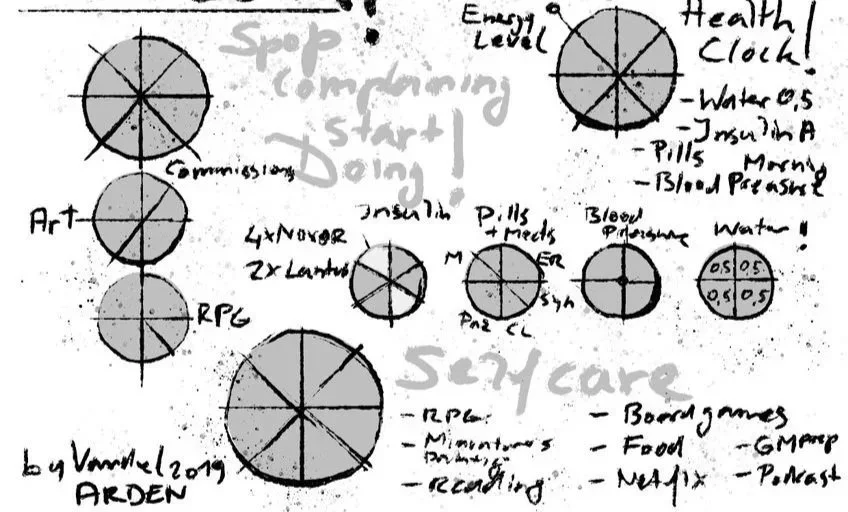
The clock is a bit of a misnomer. It’s just a tracker and functionally operates not unlike how hit points do in most TTRPGs. The main difference is that you draw a little circle and divide it into a number of segments, filling the segments as whatever you are tracking progresses. But is a circle divided into 8 slices functionally any different than a character with 8 hit points? No, but form influences use; simply calling it a “clock” emphasizes the timer aspect of it more than if it were named, “the pizza”. It does, however, look much more like a pizza. Clocks are a neat technology and there is still lots that can be done with them. Just look at, for instance, my colleague at Fallen Constellation innovations of “Tenacious Clocks”.
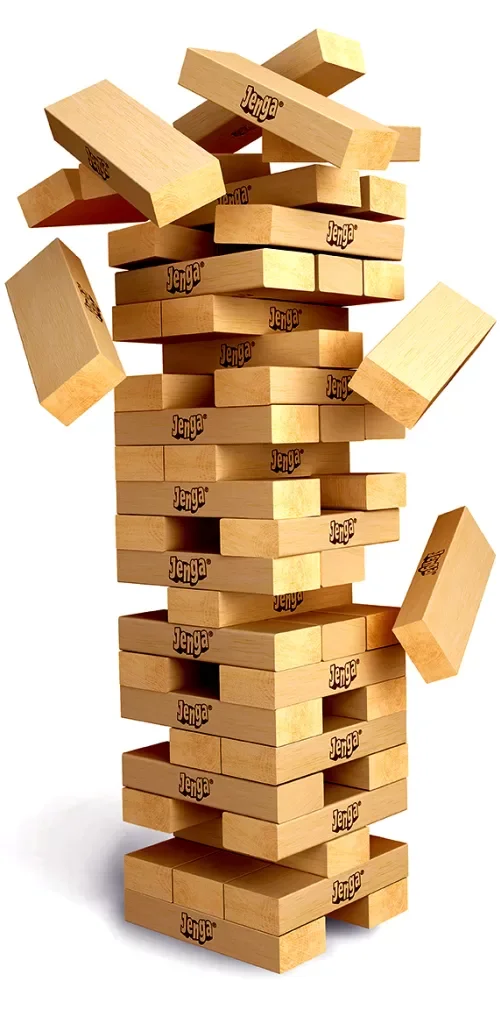
I love when a TTRPG uses common board game components. This shouldn’t come as a shock given my post about repurposing Risk and Monopoly components to play a world-building pre-campaign board game, my first adventure which made extensive use of Catan tiles, or even my bluesky ramblings about how there should be more board games that don’t use new pieces of wood and plastic and instead give you new ways to play with the plastic and wood you likely already have at home. But the most famous, perhaps infamous, usage of board game components in a TTRPG is in Dread. If you’ve heard of Dread at all it is for the fact that it uses a Jenga Tower as part of its core concept, with each pull of a block tempting fate and threatening to cause whatever horror is in play to come crashing down upon the player characters. I’m not really here to talk about Dread beyond its tower mechanic, but I can promise you that enough digital ink has been spilt on its accord elsewhere on the Internet. The main thing is that the tower is just a more active and tangible manner of semi-random time tracking in a way that feels tense due to that tangibility. You can see the tower wobble in a way you can’t actually see time pass. Whatever its flaws, that idea is at least interesting.
But I don’t want clocks and I don’t want towers! I yearn for something new. And yet, old. Since the dawn of the hobby, whenever a player has a handful of polyhedral dice, they will stack them atop each other during a session. I am certainly guilty of this as a player, as I can be fidgety when the spotlight isn’t on me, me, me the way it is when I am instead the referee. But why not harness the powers of the dice tower beyond their mere potential to busy the naughty hands of your players? Put it to work; see what it can do. Can it be the pillar by which your campaigns are given their Gygax-approved meaning?
The basic idea of the Clocktower is similar to clocks or the Dread tower except that whenever the desired amount of progress or time or whatever is being measured elapses you stack a new die on top of the tower rather than removing a block. An important caveat is that the person in charge of stacking the Clocktower should also be a person who does not desire whatever would result when the Clocktower falls (e.g., you can stack the Clocktower that means you die if it falls, but shouldn’t stack a similar Clocktower for your enemy combatant’s death). Eventually the precarity of the Clocktower will be such that it can no longer stand athwart gravity. When it collapses, whatever is being tracked happens. If you were using it to determine when a random encounter occurs, it occurs when the Clocktower falls. If you were using it to determine how damaged a combatant is, they die (or are otherwise defeated) when the Clocktower falls. That is the long and short of it. This is the same as that used to great effect in the heist game, The Job where you stack a bunch of d6s to instill tension. This post is not only reinventing the wheel (err, clock?) but also showing many different permutations of this underused but promising dice technology.
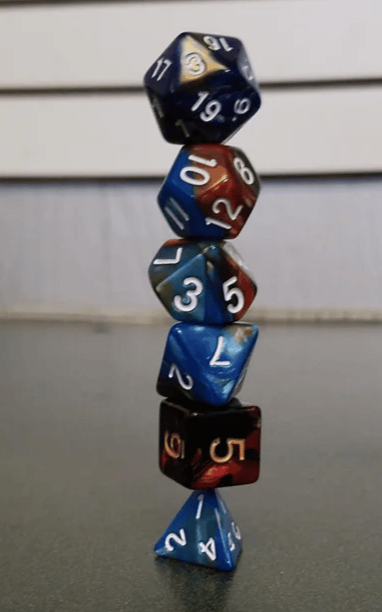
This post just scratches at a dice technology rather than hammering down any one implementation, so I am going to also offer various ways with which it can be played. The immediate question is what dice are to be stacked. D6s are likely the sturdiest while d12s and d20s produce wobblier towers. So the larger the die size (except d4s, those dice don’t really stack unless you’re a stacking wunderkind), the less sturdy the tower, i.e., the fewer notches of progress it takes for whatever is being tracked to come to pass. The dice can all be the same size with the die type indicating how many dice are likely to be stacked before collapse, or the dice can differ. For instance, if you are tracking random encounters perhaps a turn spent making a loud commotion would mean you need to add a d20 to the Clocktower while a turn spent sneaking means you add a d6. Or if you are tracking a creature’s health, add a d6 to the Clocktower for a glancing blow but a d20 when an attack is a lethal one.
The most promising aspect of this technology is that the dice in the Clocktower remain dice. Polyhedral plastic with numbered sides whose statistical potential I’ve spent hours studying on anydice and which, in the heat of the moment at the gaming table, feel as if they are divine messengers of the fates. What does this mean in the context of the Clocktower? It means that when it collapses, it tells you not only that whatever you are tracking has occurred but also that you have a new roll of the dice to interpret! For the bottommost die, which is not being rolled, I would either not count it or always place it on a side that has minimal impact on the result, typically a “1”.
There are as many ways to interpret the falling dice of a Clocktower as there is with any other toss of the dice and to attempt to catalog them all here would be a Dwizardian act of hubris. But a few come to mind which are worth mentioning. I think the ordinary method whereby you add all the dice together and take the result would probably only work in limited circumstances since it would vary so greatly with the number of dice in the Clocktower. Google tells me that the highest dice have been stacked is 12 dice high (I am incredibly dubious of this result, but perhaps it is limited to the “performance art” of dice stacking), so imagine a table that goes from 1 to 240 (in the event of 12d20) with the outlier results having such miniscule chances of happening that you time is better served by doing anything else than assigning individual results to each sum.
Instead, the best thing to do would be to either look at the highest (or lowest) die rolled for your result or count the number of dice that rolled a particular sum. Of course, there is always the chance for you to even add Yahtzee like details to the results from a falling Clocktower. I wish to give a mere three examples by which you can immediately use Clocktowers at your table.
Clocktower Case Study: Random Encounters
Each turn the player-characters spend inside the dungeon without encountering a random encounter, they stack an additional die to the Clocktower. All dice are d6 and the players can choose amongst themselves who will be the stacker (personally, I would choose whoever is the most fidgety or whomever needs the greatest motivation to not check their phone or seek distraction during the session). When the Clocktower falls, it indicates a random encounter happens. Look at the three highest dice and add them together to determine the random encounter–using three dice allows you to also determine the encounter’s reaction, number appearing, surprise and more, as detailed in my post on Overloading the Random Encounter Table.
A minor modification to the above method is to have the players instead stack either d6s for any turn where the characters are being quiet or stealthy and d12s anytime they are being loud or drawing attention. Upon a collapse, for purposes of determining the random encounter, look at the sum of the two highest dice. This means the results of 13 or higher only come out when the player-characters have been noisy enough to attract such dangers.
If you are instead already using an adventure with a random encounter table that doesn’t follow my Overloaded method, you can adjust the method based on the table size. For instance, stack d12s if it is a 2d6 table, stack d12s, stack d20s if it is a d20 table, etc. and just take the highest single die as the result.
Clocktower Case Study: Sudden Death
This method uses the Clocktower as a modification in combat that makes damage a bit more unpredictable. When each combatant takes damage, they don’t immediately subtract it from their hit points. Instead, they stack the damage die from such damage (for the first die, have the “1” side face up). Only when their Clocktower of damage dice collapses do they actually adjust their hit points, which are reduced by the total rolled. If they have time to rest while the Clocktower still stands, they can empty the Clocktower. The delayed damage represents the combatant continuously pushing their luck as the battle rages on. When the Clocktower collapses, it represents all of the pressure of withstanding attacks finally catching up on them.
This could easily be part of a core combat mechanic for a game, but it could also be a class based feature. One could imagine perhaps a barbarian’s rage being represented by the Clocktower, whereby they are shirking off blow after blow without a scratch, until the Clocktower collapses, the damage finally catches up to them, knocking them out of their battle rage. Honestly, this is probably my favorite implementations of the Clocktower for damage that I could think up. A fiddly rule is often more satisfactorily implemented when it is a feat or a class feature that someone had to opt into rather than something everyone at the player has to track.
You could also use this to model a boss monster with multiple parts and let the location of where the dice fall matter. Draw the monster and all of their constituent parts (e.g., perhaps their antennae are one hit location, their scythe-claws another, to take the example from Mindstorm’s classic Nested Monster Hit Dice) on a piece of paper. All damage dealt to the monster is stacked in a single Clocktower. When the Clocktower collapses, it deals damage to the various parts based on the amount rolled and based on the location the dice land. If any dice land outside the drawing, they are dealt to the monster’s general pool of hit points. If any single hit location is reduced to 0 hit points before the monster is slain, it loses whatever functionality is associated with that part. I frankly don’t love this example because there are much better methods (by which I mean methods that give more impact to the player’s choices) methods for the multi-part boss monster, but I just wanted to give another example for the ways in which you can play around with the physicality of the Clocktower.
Clocktower Case Study: Downtime
Clocks are most frequently used in POSR games in the context of downtime. For instance, most of the long-term goals that player-characters can pursue via the downtime actions described by Downtime in Zyan involve tracking such goals via clocks. My colleague at Among Cats and Books built on this in a blogpost also focused on urban downtime. So how can Clocktowers be used to add on to these methods? Essentially the same way, but with the GM stacking Clocktowers for each activity being progressed. For each progress toward the goal, add a d12 (a precarious die for stacking) to the Clocktower. Set the bottom die with 1 facing up.
A collapse represents completion of the goal, but it also gives the opportunity for the referee to augur what else occurred while the player(s) were focused on accomplishing their goal. While there are probably a few ways to skin this cat, I would suggest the referee come up with 12 major factions or important NPCs in the settlement. Assign each faction/NPC a number from 1 to 12 (with the more dangerous and/or more hostile to the players receiving the higher numbers) and give each their own goal they are trying to accomplish. When the Clocktower collapses, if there are any dice that match, the faction/NPC whose number matches those dice also accomplished their goal while the player-character did. If no dice match, the player encounters a representative of the faction/NPC based on the highest die rolled.
The exact examples are presented here purely to get your own juices flowing and introduce some possibilities of the Clocktower. I look forward to seeing others find even more wild and ingenious uses for this dice technology. At its core, it emphasizes the tactile fun of playing with dice in a physical space. It would be hard to replicate when playing digitally, but frankly, I think it is fine for there to be some tabletop gaming experiences that are best, or maybe even only, experienced at the actual and not merely metaphorical table. Go stack some dice and watch them fall.