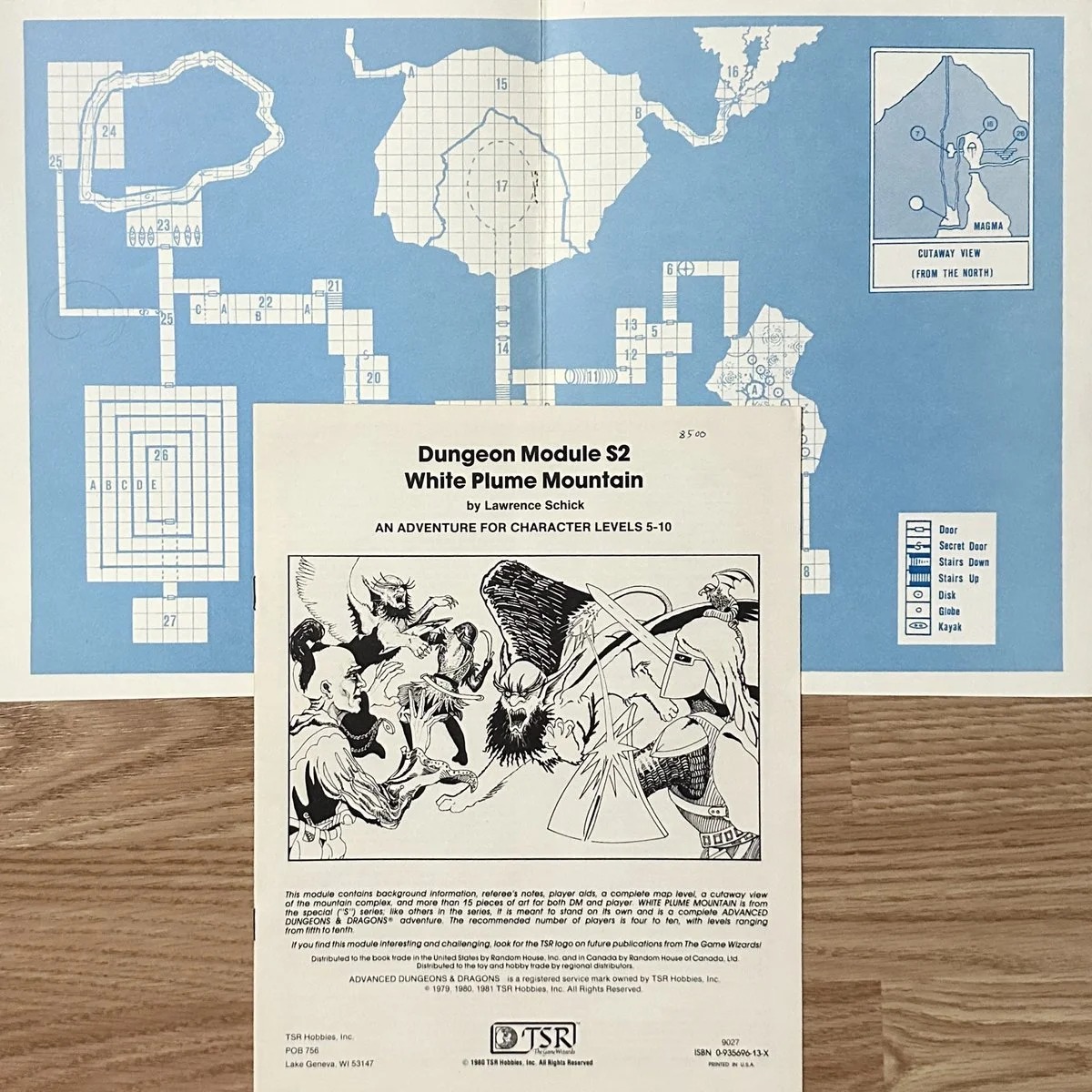
Rating Every Room in White Plume Mountain
White Plume Mountain is a classic module with somewhat mixed reception among the OSR types. It is the ur-example of a “funhouse” dungeon, which Webster’s Grognardia defines as “an adventure where naturalistic concerns take a backseat to challenging the players, regardless of logic (or lack thereof).” Games abiding by a consistent logic are, as I’ve previously argued, the cornerstone to the promotion of player agency that is so core to the P/OSR playstyle, which is why White Plume Mountain is not held in the same great esteem of grognards that The Keep on the Borderlands often is, fairly or not. But this funhouse dungeon module still holds a special place in my heart because it is, above all, fun. (It is not, however, a house, in any sense of the word.)
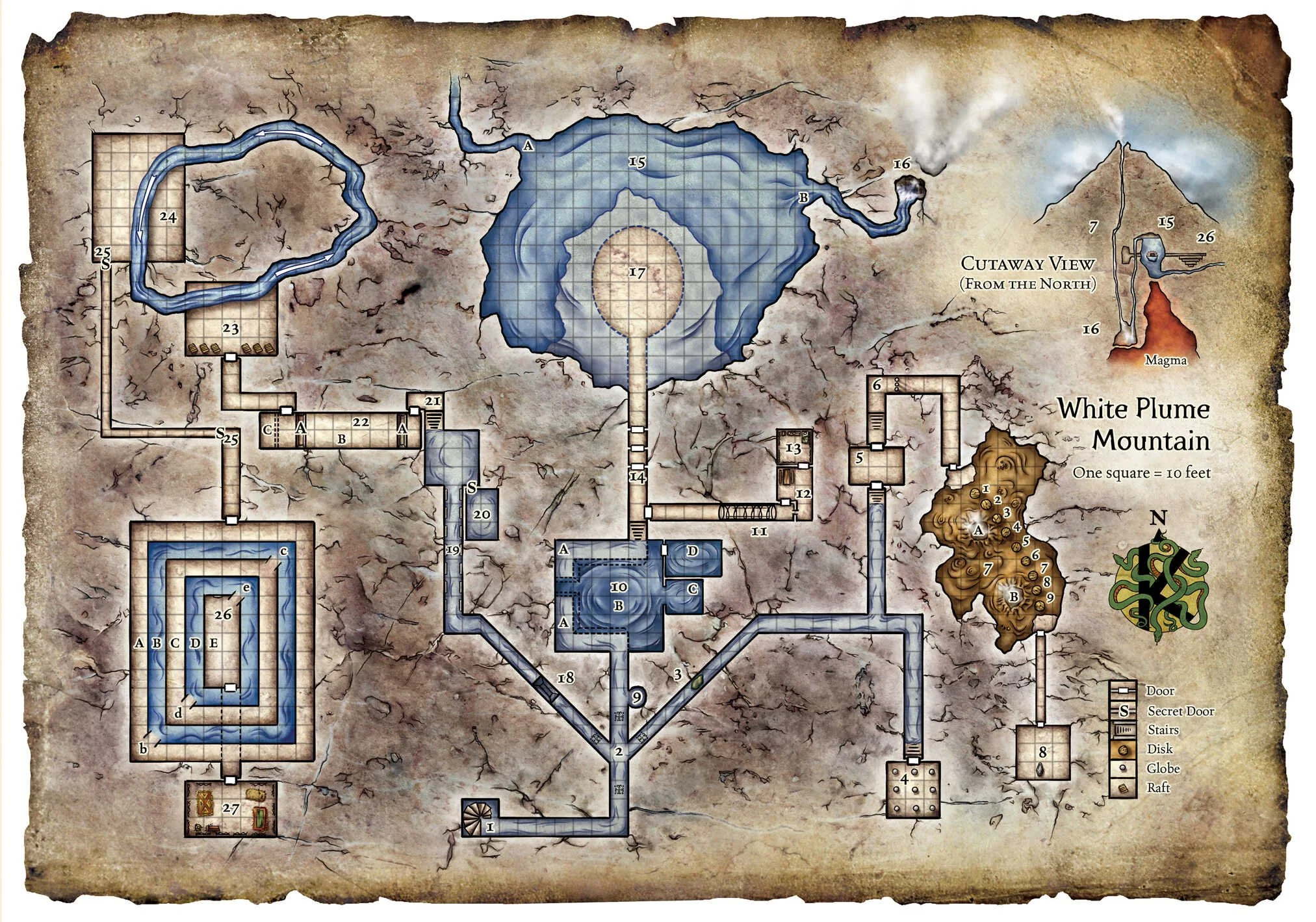
White Plume Mountain is no megadungeon. It only has 27 rooms (which I suppose is basically a megadungeon if you are accustomed to five rooms masquerading as a dungeon [although, as my colleague, Gus L. at the All Dead Generations blog, persuasively argues, five rooms do not a dungeon make]). But they are jam-packed rooms; each is interesting and none are totally empty. In fact, a massive, but often unsung, merit to the funhouse dungeon is that it is highly stealable content. Each room (or sometimes a pair of rooms) is rather standalone which makes for a bit of a zany overall effect taken in totality but also makes it easy to pluck a single room and drop into whatever dungeon you happen to be running. And the limited size of White Plume Mountain allows it to be the latest victim of my very occasional tradition of giving things a 1 to 5 star rating. Without further ado…
Room 1. Entrance and Spiral Staircase
★☆☆☆☆
Room Summary: A muddy cave with a hidden trapdoor to a spiral staircase leading to a waterlogged corridor.
(Blogger’s Note: I am combining the first room with the unnumbered cave that is the actual first room of the dungeon. It isn’t clear why it’s not a numbered part of this whole shebang.)
If you only have one entrance to your dungeon (and that entrance only has one exit), this entrance is an excellent example of what not to do. It is essentially a wet, muddy area where the way to the next and only adjacent room is hidden by inches of muck. As the adventure says, “Only careful probing of the muck near the back of the cave will reveal a small trap door with a rusted iron ring set in it. Once the muck has been cleared away it will require at least three characters of strength 16 or better to pull up the encrusted door.”
So there are two ways to run this entrance: either it is just an evocative introduction to the dungeon but finding the and opening the trap door is essentially a foregone conclusion, i.e., empty room with set dressing, or in the alternative you actually allow a meaningful chance of failure to find or even to open the door to the dungeon, which means a chance of skipping the dungeon altogether. The reason why allowing odds of failure, typically an essential part of running a meaningful game, is a total party buzzkill here is that, okay, so you don’t find the door. Guess this is just a muddy cave, let’s get moving to our next destination. Dungeon over. Hope you prepped a second, better dungeon for tonight.
An easy solution to making this a 3-star room is to either add another entrance or two to the dungeon or multiple exits from this room. The theory is the same, finding and opening the door is now no longer a 1st room chokepoint; it is additive for the players, either giving them more choices about where to go next or rewarding them by placing more advantageous stuff, potentially some loot or less danger or just a quicker entrance, behind the semi-blocked path.
You came here for ruthless dungeon room ratings, but ratings sounds like ravings if you’ve had too much to drink, so you are also going to get some dungeon advice snuck in. If you want to have multiple dungeon entrances (which you should want), I would categorize dungeon entrances similarly to how my colleague Anne of DIY & Dragons categorized dungeon rooms in Landmark Hidden Secret: you can have an Obvious Entrance, where the player characters can immediately enter the dungeon and know about the entrance just by looking at it. This is the big front door to the dungeon with great, big brass knockers. But you can also have the Hidden Entrance, an entrance that they have to at least declare that they are looking in the right place to discover. If the trap door was just hidden by muck and players had only to kneel down and grope around like they lost their glasses in a dark and crowded room in order to find it, this would be a Hidden Entrance. But instead, it is a Secret Entrance, because it is both non-obvious and has a chance of failure: if you don’t have 3 or more greased up strongmen in your employ, you can’t open the door even if you know exactly where it is! I would advise including a number of dungeon entrances equal to at least the number of dungeon levels plus one, with a mix of entrance types, but at least one Obvious Entrance. However, one caveat should be that the Obvious Entrance should always be the most treacherous. It is the one the dungeon’s denizens expect you to enter and they likely have traps or guardians set to prevent would-be adventurers from venturing any further. After all, if the Obvious Entrance is a cakewalk, some other adventurers have probably already cleared this place of its treasures, and it isn’t much of an adventure site without Dangers & Discoveries. That’s why they call it D&D! (citation needed)
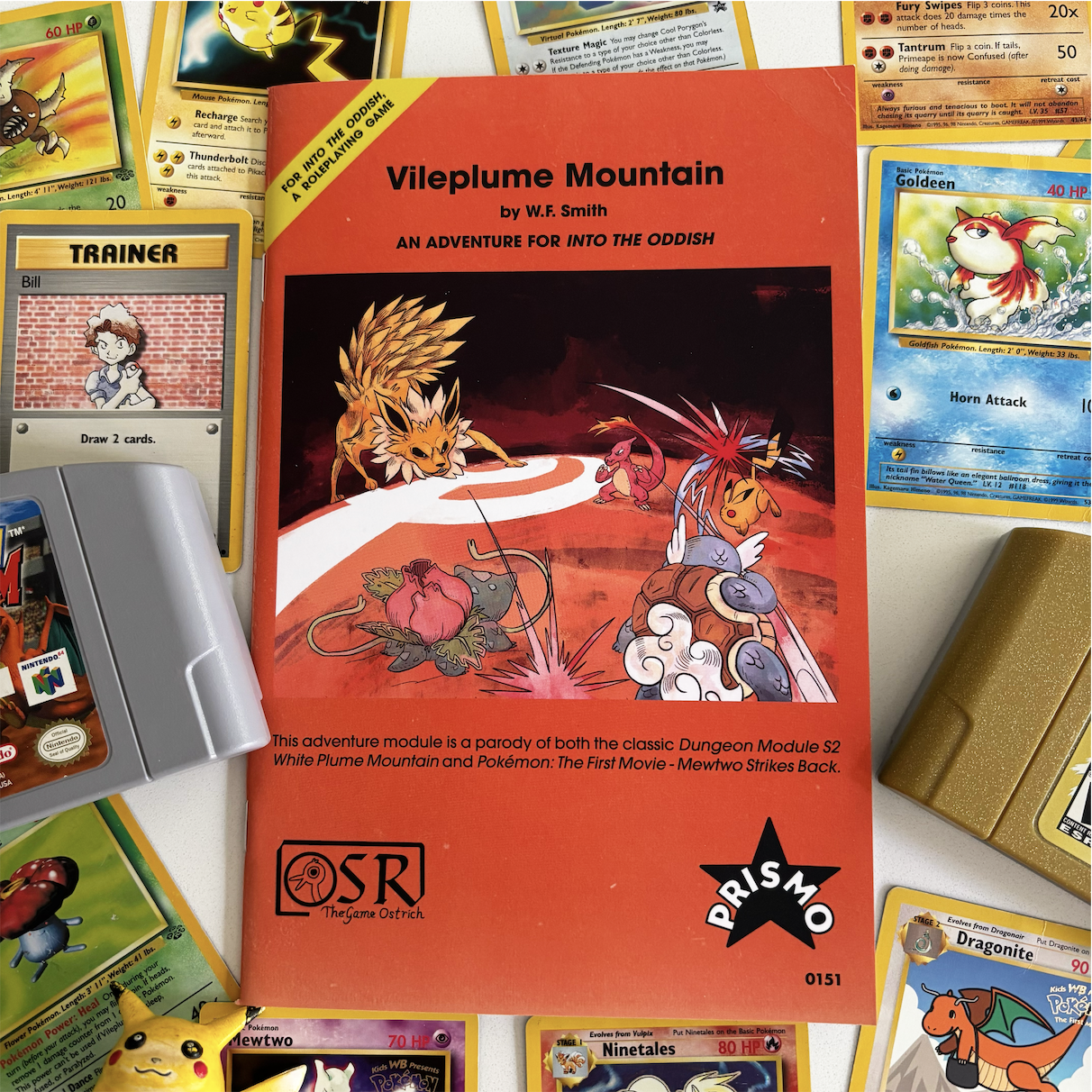
Speaking of White Plume Mountain, if you are looking for a parody of the original adventure, with some quality-of-life improvements and modernizations, and a certain pocket-monsteresque flair, you may be interested in…
You have received a letter from a mail-delivering dragon. It is addressed from a powerful wizard
Thirteen years ago, the now-mythical humans created a powerful wizard in a laboratory…
Vile Mountain is a parody of the original funhouse dungeon reimagined as a Pokapocalyptic ruin filled with hostile pocket monsters and devious traps set by a legendary wizard.
What’s in the Adventure?
27 dungeon rooms filled with dangerous monsters, brain-teasing traps and valuable treasures like new Technique Machines
5 new moves from for Into the Ish
27 enemy monsters that are not included in either base Into the Ish game (all of which are compatible with other Into the Odd-like games, like Cairn)
Designer commentary from the designer who has also ran White Plume Mountain for many groups over the prior decade
Writing by W.F. Smith (Prismatic Wasteland), Front Cover Art by Sam Mameli (aka Skullboy), Back Cover and Interior Art by Hodag RPG (aka the Hodag), and Layout by K.T. Nguyen (Barkeep on the Borderlands)
What You’ll Get?
The book: 36 pages, stitch-bound zine, digest size (5.5” x 8.5”), full color cover and black-and-white interior
The downloads: A hyperlinked PDF of the adventure
Need a system to run it with? Bundle this with either the Red Version or Blue Version of Into the Ish for only $20 more! Or get them all for $10 off the total sticker price. However, this adventure is playable with Odd-like games such as Cairn.
When You’ll Get It:
Now! Pre-Orders have been fulfilled and these are shipped out as they’re ordered.
Room 2. Riddling Guardian
★★☆☆☆
Room Summary: A flooded intersection guarded by a squatting gynosphinx.
Freedom, as a concept, had not yet been discovered at time of publication in 1979 (and much debate still surrounds it all these years later). This room is yet another potential chokehold room but slightly more fun. The sphinx blocking the forked passage is aided by an invisible forcefield, so if the player characters can’t answer its riddle, then the adventure now ends at room #2, with room #1 being essentially empty. The riddle is, at least, exceedingly easy, but why include a chokepoint with essentially no chance of failure?
I typically play up the “mangy, bedraggled” aspect of the sphinx here. The sphinx isn’t happy to be here, basically hates its job (and its boss, all very relatable), and takes no pleasure in sitting in a sewage pipe just to block potential treasure hunters. So, if the players don’t solve the riddle, they may be able to roleplay past it by negotiating with the sphinx. This way it isn’t an entire non-choice room. There is also the opportunity to fight your way past the sphinx, I suppose, but if it comes to blows here, something is wrong, probably with your player-characters more than the adventure.
Room 3. Hidden Slime
★★☆☆☆
Room Summary: Slime floating on a watery corridor.
Slimy water that eats the boots off your feet before it starts on dissolving those toes. I like that there are solutions (fireball spells) but that the “usual flask-of-oil method” (usual to whom? A whole different article could be written about the assumed play culture of this module but in short the answer is probably “classic” style players) won’t work. I have no qualms with this area, other than it just being a bit ho hum in comparison to the more out-there and memorable rooms in this joint. Three rooms in and no banger rooms yet. Probably a good idea to get some of your best ideas at the start of the dungeon instead of stringing along a handful of duds first.
Room 4. Glass Globes
★★★★☆
Room Summary: A mucky room with nine silvered glass globes suspended from the ceiling.
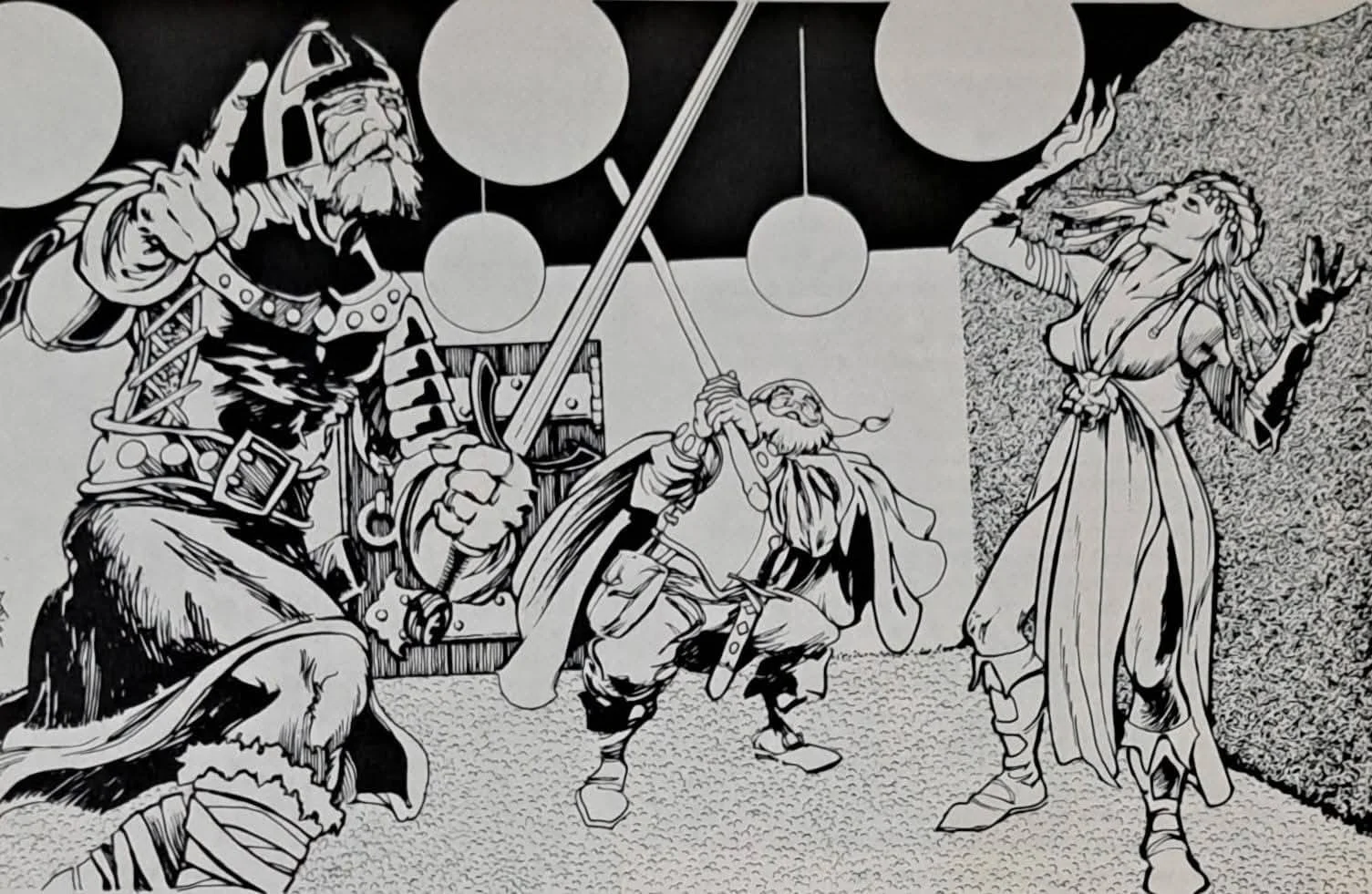
The locked door and globes full of treasure again present problems for player agency. The door locks in a very heavy-handed way where even foresight, smart precautions by the players or magic can’t open it (“No spike, hold portal, knock, or passwall will open the door or keep it open. Only the proper key turned in the keyhole on the inside of the door will unlock its magic”). You must rifle through the globes to get to the key and, even if you didn’t, why would you not go through them? The rewards far outweigh the risk, and it’s fun like unboxing those mystery-box toys that kids-these-days are wild about. RPG players especially love opening a mystery box, consequences be damned! If you describe a mushroom growing on the dungeon walls in any sufficient detail, odds are good that at least one player will choose to make their character eat it or be sorely tempted to do so. Especially if I’m one of your players. Carrots are so tasty that sticks be damned!
The real juice of this room is the weird ring which the module describes as a “basic loyalty and intelligence test.” But the way this is described and how it turns out if you play it as written is more likely to devolve into a bad escape room. Too much of this module, especially the early part, is a game of “guess what is in the dungeon master’s pocket”, which isn’t particularly fun. The players may be delighted to spend an hour fighting over a ring that turns out to be trash, but this is a real your-mileage-may-vary sort of “challenge.” The ring dialogue is very funny to read, however. It’s so goofy. I love that it diegetically says “I eat one hit point per year permanently”. Do the player characters know what hit points are? It is silly enough that it earns this mid-tier room an extra star for being absolutely iconic.
Room 5. Numbered Golems
★★★★☆
Room Summary: Five golems in a police lineup in a rectangular room.
I know that in the 1970s that D&D was more associated with your standard STEM-loving nerd than, as is the case today, the theater-kid sort of dweebs, but did this dungeon really need a riddle where the answer is that “9 is not a prime number”? The fact that, if you don’t correctly answer this math problem, you get pummeled to death by 5 flesh golems. Coolmathgames.com would never be so bold. The fact that this room either ends in a bloodbath or getting a flesh golem follower is definitely impactful, I just wish it didn’t hinge on solving a math problem in 60 real life seconds. However, I have no choice but to give this room 4 stars. Not 1, not 2, not 3, not 5, but 4. Can you guess why? Put 60 seconds on the clock. If you can’t, I will be sending 5 Frankensteins to your door to fucking kill you.
Room 6. Turnstile
★☆☆☆☆
Room Summary: Literally just a turnstile that only turns counterclockwise.
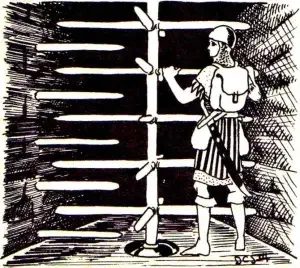
Is this room some existential joke at D&D’s expense? Is the dungeon literally an amusement park? I have once replaced the ordinary turnstile with a talking door but that turned out even worse somehow, eating up more time that this room deserves. Instead, I now replace it with a full set of metal detectors, x-rays, etc., à la modern airport security. Characters must take off their shoes, which honestly doesn’t happen enough in dungeons.
Room 7. Geysers and Chains
★★★★★
Room Summary: Platforms suspended by chains above a lake of boiling mud, with two geysers spewing scalding steam at different intervals.

I love mini-games in TTRPGs (e.g., my cooking minigame which may or may not have been adopted by Daggerheart), and the disks are a great time to deploy a simple mini-game. But the best part of a mini-game is to complicate the game midway through when the players have had some time to develop some mastery over how the geyser and disk-jumping game works. The next room provides an opportunity for exactly that, which I’ll talk about below. But I love where dungeon rooms work together like these two. 8 is a dead-end, so players have to backtrack, but 7 gives a chance for that backtracking to be very different, more tense, and not at all tedious. You may well survive the trip to room 8 just to plummet to a muddy death on the way back.
Room 8. Coffin
★★★★★
Room Summary: A coffin lying atop a pile of treasure. A dwarf vampire’s here too.
Ctenmiir, the dwarf vampire and wielder of the legendary hammer, Whelm, is always a delight to run. It is also a prime example of the “One More Thing Principle”. Just adding one more element always fleshes out an encounter and provides that conceptual density that one craves in a published TTRPG adventure. Vampire? Generic. Dwarf vampire? I’m listening. Dwarf vampire cursed to guard treasure? I’m taking notes. Dwarf vampire cursed to guard a talking hammer that is racist against trolls, giants and goblins? I’m getting in my car and driving there immediately.
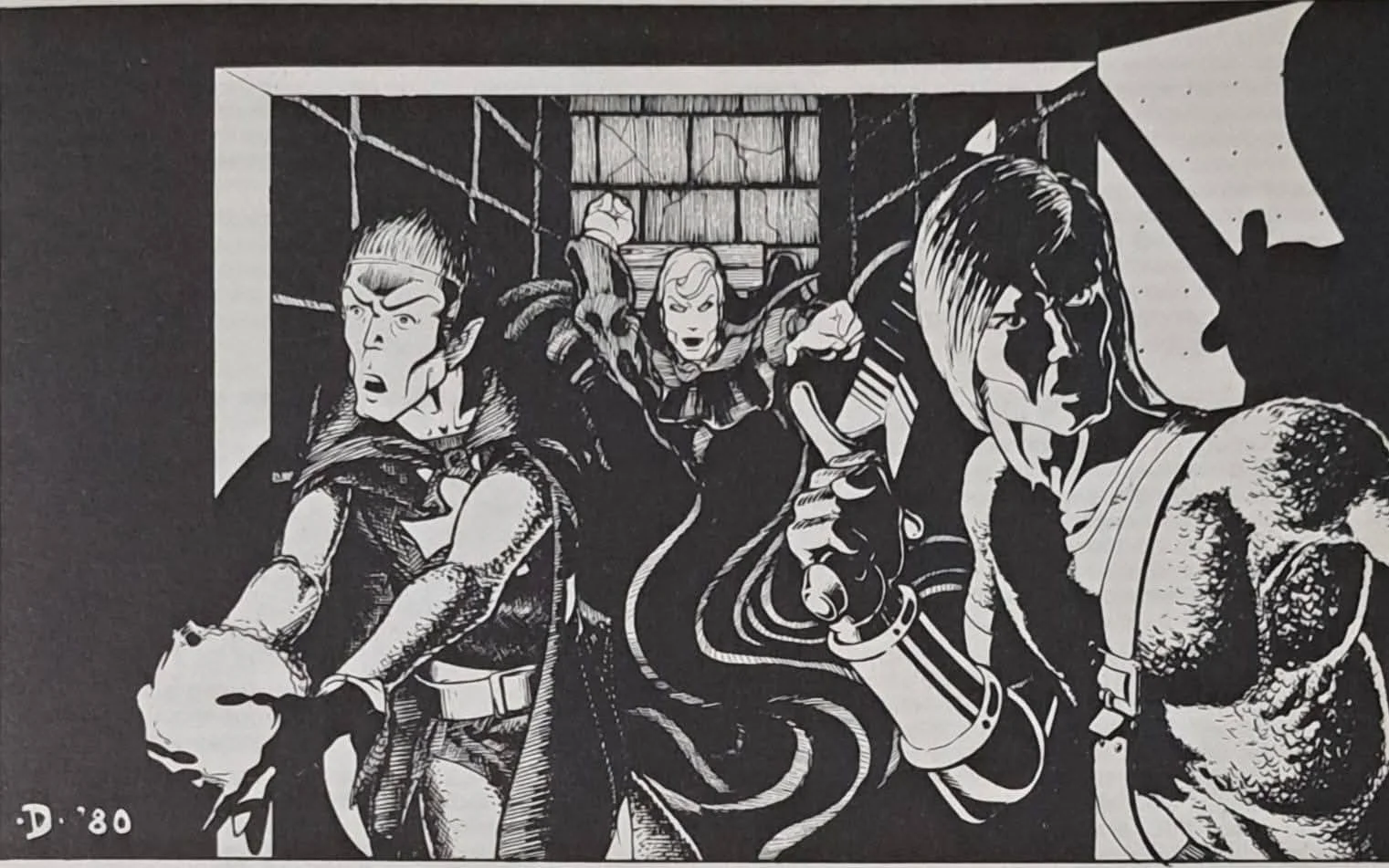
How does this combine with the geyser room? The best way to play these two rooms out is to allow the player characters to grab the talking hammer and flee, only to be in hot pursuit by a vampire that can turn into a bat or floating mist. Ctenmiir is going to fly over and fight the player characters while they are jumping from platform to platform above their certain doom. That is already a recipe for one of the most cinematic battles you are likely to run, but because the players have been here before and wise players will have learned how the pattern of the geysers work, there is even a chance for those wisest of players to use the environment to their advantage to take down the vampire. Imagine the dwarf vampire getting blasted to near-death by a well-timed hydro pump. This makes rooms 7 and 8 a wonderful one-two punch!
And as far as treasure goes, Whelm is not too shabby. A talking weapon is great, it is genuinely very useful (stuns enemies, sends shockwaves when you hit the ground, returns to your hand when thrown, can detect gold, gems and goblins. Thor, eat your heart out) but, more importantly, comes at a cost: it gives the wielder “a severe case of agoraphobia.” It is a dwarven weapon that makes the wielder more stereotypically dwarven: you will now prefer to stay underground and are more confident fighting goblins and better at finding gems and gold buried underground. And Whelm isn’t even the only treasure to be nabbed–there is a potion of ESP, of black dragon control, a number of spell scrolls, and 10,000 in gold for your troubles. But “trouble” is the operative word for greedy players trying to carry the 6 leather sacks of gold across room 7 while being pursued by a vengeful vampire. When a character fails their save, give them the option to not slip off the disk but only if they are willing to drop one of the sacks of gold to grab the chain. Trust me, players hate this but in a good way. Oh no, I’m in a conundrum of my own making!
Room 9. Pool and Drain
★★★★☆
Room Summary: A pool of water with a valve underneath that, if turned by two strong characters, drains the waterlogged corridors.
This is actually a great room. It is simple and nowhere near as flashy as the other iconic areas in this dungeon but it is incredibly toyetic, and there aren’t enough dungeons that allow the players the ability to change how the dungeon operates. The water temple in Zelda: Ocarina of Time comes to mind, but obviously, this isn’t nearly as complex and, importantly, is entirely optional. It is a reward for observant players with strong characters at their disposal and a potentially useful tool for a clever party. There is also the secret torture chamber at the bottom but only for those with their Detect Magic on. That’s just a little added treat.
Room 10. Deceptively Deep Room
★★☆☆☆
Room Summary: Another waterlogged room of varying depths that is home to sexy, sexy seaweed demons.
The “trick” in this room is that part of the room is 15-feet deep while the rest is just 1-foot deep and the deep area is home to kelpies, sea demons that charm male characters. (The assumed heterosexuality of all characters is due to this being a module from the 1970s, but surely an expressive medium where the only limits are your own imagination can reasonably anticipate that a player may play a character that isn’t straight. You can play as an elf or a dwarf but a gay character is a step too far? The monster manual included with the adventure gives the justification for women’s immunity to the kelpies’ charm as being “because kelpies were created by the sea-god as punishment for those men rash enough to sail the oceans without paying their lord his proper respect. Women were not involved in these transgressions”, but this explanation is not very convincing because presumably there have been some women who have sailed the sea without conducting proper worship first. Were gay men involved in these transgressions or were all these sailors totally straight?) The kelpies will drag charmed characters to their underwater depth that houses assorted treasure, presumably from other men taken in by their charms. The “sexy lady monster” is an incredibly common trope in dungeons of the 1970s (the ur-example, in my mind, is the medusa in Keep on the Borderlands, which I wrote an entire blog post on) and this one doesn’t really take it in any new or interesting directions other than introducing a monster. Although, even that is disappointing to me because I prefer the mythological kelpie which shapeshifts but whose true form is a horse. I just find the idea of being catfished by a horsefish much funnier than just a soggy seaweed mermaid.
Room 11. Spinning Cylinder
★★★★★
Room Summary: A spinning metal cylinder coated with oil and painted with a dizzying pattern.
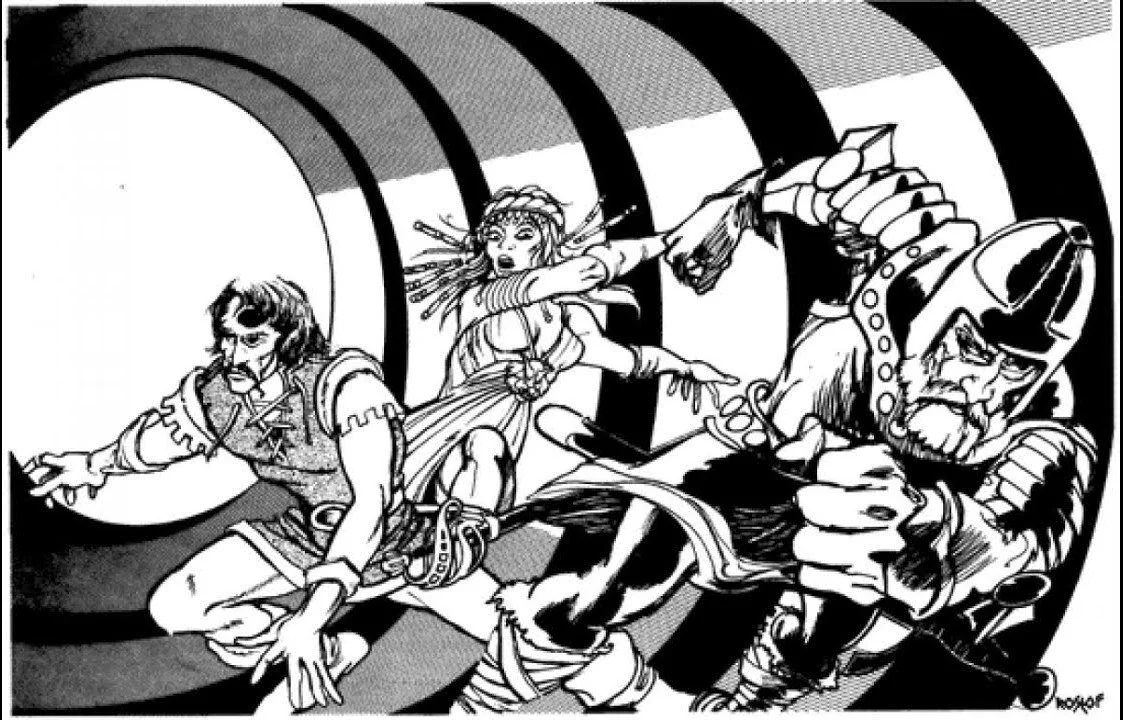
This is a hilarious room. Who the hell would build this and bring it into a dungeon? Just incredibly silly. It belongs in a McDonald’s playground that got decommissioned in the early 90s after several serious injuries. Peak funhouse dungeon design. But it gets better when combined with the next room.
Room 12. Burket’s Guardpost
★★★★★
Room Summary: A simple room with a table, benches, a spellbook and candlestick, guarded by a fighter-simp.
Imagine you are crawling through a slowly moving and dizzyingly designed tunnel that is covered in a slippery oil making it impossible to stand up without falling over. Then you see, on the other side of the tunnel, a smirking fighter with a flaming arrow and you realize: this oil is flammable, isn’t it? That’s exactly what is going on. The guard shoots the flaming arrow when they are past halfway in the tube, then goes to warn his werewolf-witch lover. Simple but effective. I wonder what the rent is in a two-bedroom windowless unit that is only accessible by a spinning tunnel?
Room 13. Snarla’s Sanctum
★★★★☆
Room Summary: A beautifully ornate room with oriental rugs, erotic tapestries, mosaic ceiling, lavish bed, a buffet of sweetmeats and cakes and a werewolf-witch.
These rooms are your typical one-two-three punch. They are almost like a Rube Goldberg machine where the players’ entering the tunnel sets in motion a catastrophe for those same players. Clever thinking or luck is required to avoid getting trounced.
Snarla, which is an excellent name for a werewolf-witch, is warned by her boyfriend and likely moves into this room to prepare for further combat, if she doesn’t decide to fight alongside her lover, Burket (another excellent name). Snarla is in charge of feeding the kelpies and other dungeon denizens, but she has gaps in her memory for anything involving her employer. Setting up a little mystery regarding the master of the dungeon and putting in the DM’s mind the fact that this isn’t just a combat encounter; it’s a potential social one as well.
All of the fancy food are actually iron rations gussied up with illusions and the bed is similarly an old straw tick and the furnishings are bare. The chest can only be opened by a command word known to Snarla or else will dissolve into a stinking cloud. I don’t hate this trap because it is at least telegraphed that the contents of this room have been subjected to sinister magics, but I would like a bit more signposting before making a chest full of treasure turn into a noxious cloud, especially if the players already killed Snarla. Perhaps there is a chance to guess the codeword with enough study of her spellbook?
Room 14. Flood Doors
★★★★☆
Room Summary: A series of metal doors that all open out in the same direction.
This is nice, subtle telegraphing of the danger that lies ahead. Maybe too subtle because I’ve never had a party realize “huh, are these like emergency doors designed to seal off a leakage of boiling water in the event of a catastrophe?” But I have had players who realized it after the fact, after the catastrophe. The reason I cannot in good faith award 5-stars here is the mere fact that in the midst of all the extra stuff going on in this dungeon, this set of doors feels like it could use a slight punching up. Remember the “One More Thing Principle" from Room 8? If that could’ve been employed here to give a bit more juice, I could find it in my heart to give it that extra star.
Room 15-17. The Boiling Bubble
★★★★★
Room Summary: A stone ledge in a boiling lake, where “just about the biggest giant crab anyone’s ever seen” guards a pile of treasure, protected from boiling water by a big magical bubble.
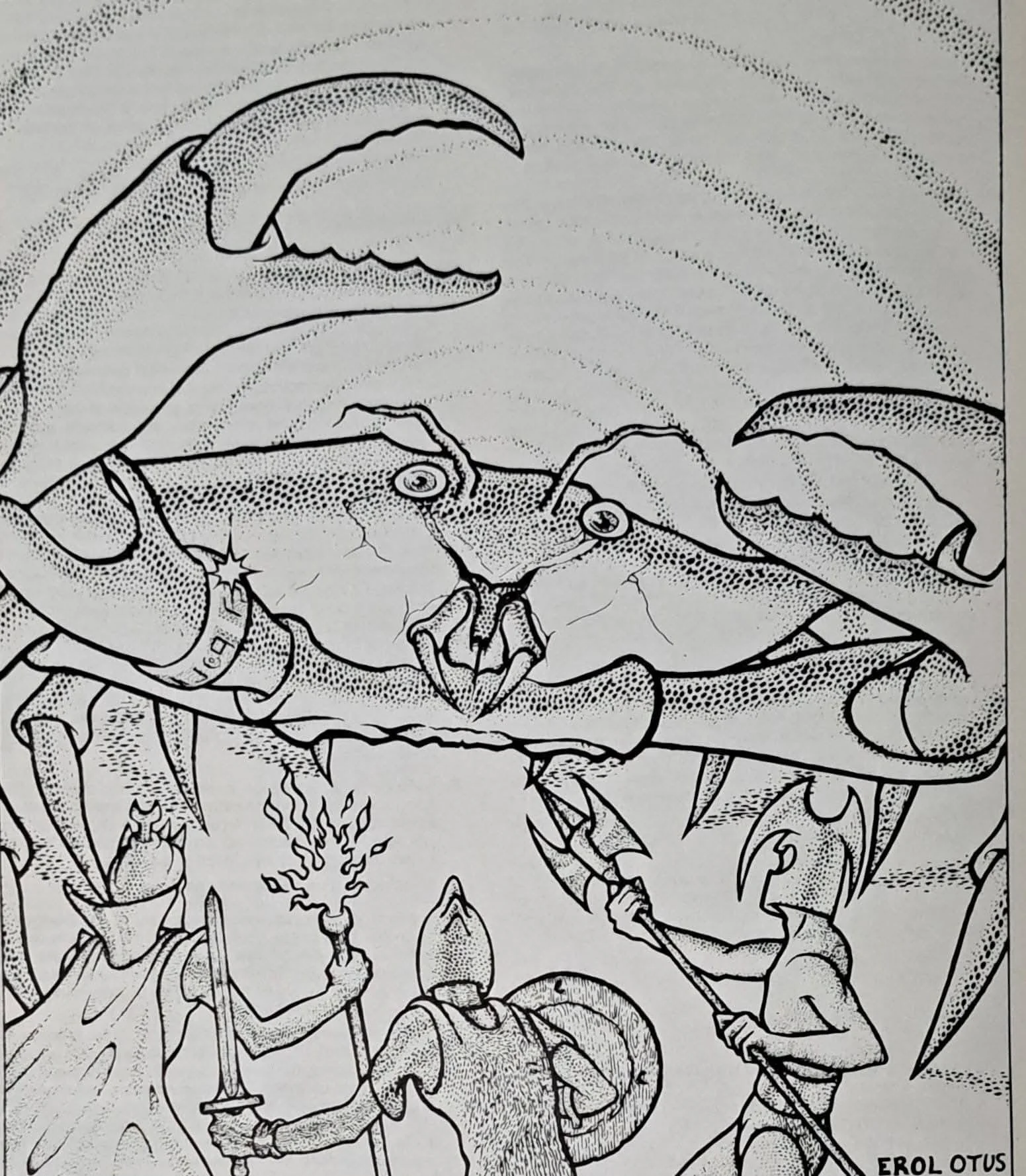
Rooms 15 and 16 are just the hard exterior to the juicy meat in Room 17. The purpose of those rooms is just to get the DM to understand the dynamics (or perhaps the thermodynamics) at play in this encounter. Then you get to the fact that the players have entered this boiling lake, protected only by a big magical bubble that can be easily punctured. As if that weren’t enough, there is a giant crab here, guarding a trident that will turn you into Aquaman. Making combat interesting is less about what monster or monsters you are fighting, or even the tactics of those monsters, than it is about where you are fighting them. And fighting inside a boiling lake where a stray lightning bolt spell is “likely to get the whole party boiled” is sufficiently interesting that the enemy doesn’t need to be a fancy dragon. It can just be a big ole crab. I also love to roleplay this crab, which is described as being somewhat intelligent but not sapient nor capable of speech. I describe the fear in its beady crab-eyes and the way it swings its forearms to hit the party but with a very careful motion to avoid hitting the forcefield. No one is more concerned about the boiling water than the crab.
In one of my more memorable experiences running this room (way back in my 3.5 days), the party felt too bad for the crab to want to kill it, even for the mound of treasure it protected. So they left and found a way to turn the crab into a Figurine of Wondrous Power that they could take with them safely out of the dungeon. The giant crab helped them out quite a few times and it was often joked that it was their Pokémon. Me, White Plume Mountain, and Pokémon all go way back.
Room 18. Hall Pit
★☆☆☆☆
Room Summary: Just a pit full of water.
Okay, let’s assume I “fall” into the pit. There is nothing in the 10-foot pit other than water. So I just swim back up. Is anyone venturing this far into the dungeon if they can’t swim? Am I supposed to be afraid of a regular swimming pool? One star.
Room 19. Metal-Heating Corridor
★★★★☆
Room Summary: Metal-platted room that heats metal passing through.
I really like this room. It is harmful (possibly very harmful) to unthinking player characters without being either a monster or an untelegraphed HP-tax type of trap. Of course, that doesn’t warrant 4 stars by itself. The real juice is that once players learn about how the room functions, they can use it against enemies. However, this room would be improved if the enemies in the next room wore metal armor. I am also deducting points for the fact that the heating plates “cannot be damaged or removed”. Why frustrate clever play?! It can still be very hard to remove, but if the players manage it, they should be rewarded with a potential solution of getting to install the plates elsewhere in the dungeon to frustrate a future foe. Or maybe carry it back to Room 17 and cook a crab for dinner.
Room 20. Ghoul Ambushers
★★★☆☆
Room Summary: 8 ghouls waiting patiently in a secret room.
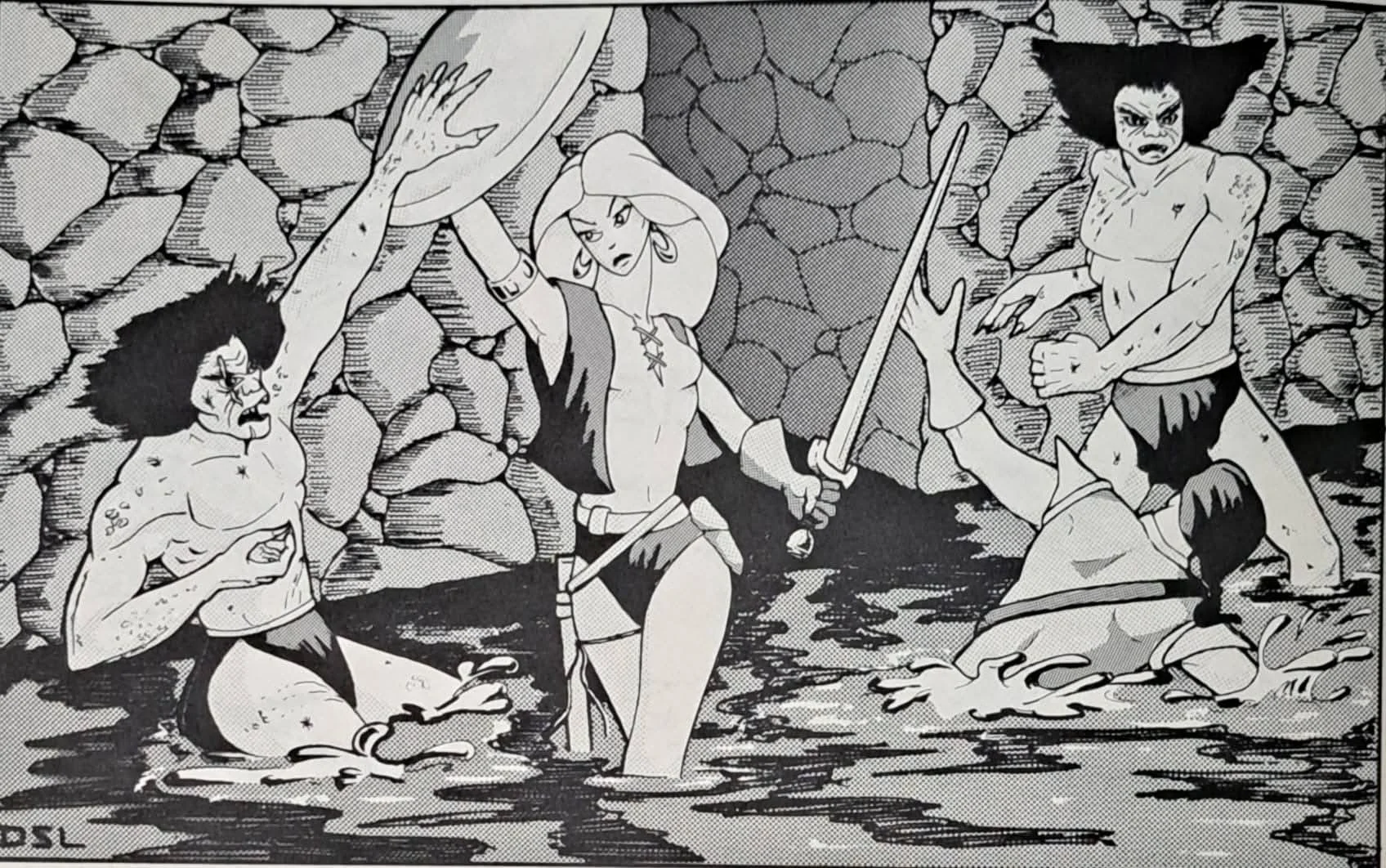
This dungeon is very much a believer in the one-two punch. The real reason for Room 19 is to bully the player characters into removing their metal armor just in time for an ambush. That’s dastardly, and I certainly admire it. However, there are a couple of ways I would improve this combination of rooms. First, as I mentioned above, it would be more interesting if these foes had something metal themselves so clever players could give them a taste of their own medicine if they found a way to lure them back to Room 19. Second, the way this ambush is set up does not make for a sporting challenge. The 8 ghouls are behind a secret door, just chilling, but there is no indication of a secret door. In fact, there is really nothing in this room at all that can be described to the players. It starts right away with “Behind the secret door”. What if, instead, you had a dry portion of the room with benches and hooks on the wall but, if the player characters spent time looking at the dry floor, they could see scratch marks on the floor around the benches. Characters who want to don back their metal armor are obviously going to sit on the benches, and that could be the signal for the ghouls to come out and attack their naked prey. These are two good rooms in theory, but they lack something in execution.
Room 21. Stairs Up
★☆☆☆☆
Room Summary: Stairs, leading up.
Why is this a room? It should be combined with Room 20 to give the referee something else to describe other than giving any clue about the secret door.
Room 22. The Frictionless Room
★★★☆☆
Room Summary: Walls, ceiling and floor are “100% frictionless”, except for open razor-pits.
You can tell this one is going to be good because it’s the only “named” room in the adventure. The description starts simply: “The Fictionless Room” (emphasis added). No other room gets any similar caption. But the name doesn’t do the room full justice; aside from the walls, floors and ceilings being covered in an unremovable slippery substance that prevents anyone from standing upright and instead causes them to careen around the room like billiard balls (this analogy is from the module itself, and I found it quite charming), there are also two pits full of rusty razorblades for those billard ball PCs to land into, those razorblades cause, in addition to the ordinary damage, “instant super-tetanus” causing death in 2-5 rounds, and the wall at the far end is illusory, such that anything that passes through it appears to those on the other side as if it just disappeared through the wall.
The best trick rooms in dungeons provide toyetic obstacles for which many solutions are possible. A recurring problem with White Plume Mountain is that it wants to hem in the possible solutions. This room goes to great lengths to forestall possible solutions. The slipstuff is “totally unaffected by any force, magical or otherwise”, so good luck washing or burning it off. The spells fly, levitate, jump, dimension door, blink and teleport simply don’t work in this room. Why? Go fuck yourself, that’s why. And the false wall is intended to “foil schemes for attaching ropes to the west wall from afar.” The module explains what you would like to guess is in its pocket by saying the trick is to string a rope through the room and fasten it securely at both ends. It then says, “A clever party may even be able to come up with other methods. Ingenuity is required.” However, it forestalls so many possible solutions that one is left with the impression that the designer would really prefer you solve it their way and if they knew of more “other methods”, they would have added an extra sentence to outlaw those as well. It truly pains me to have to deduct two stars from what is otherwise a very fun room, but the heavyhandedness deserves a heavyhanded penalty.
Room 23. Floating Stream
★★★★☆
Room Summary: A stream of water floats through the middle of the air and passes through tunnels between two rooms. There are kayaks.
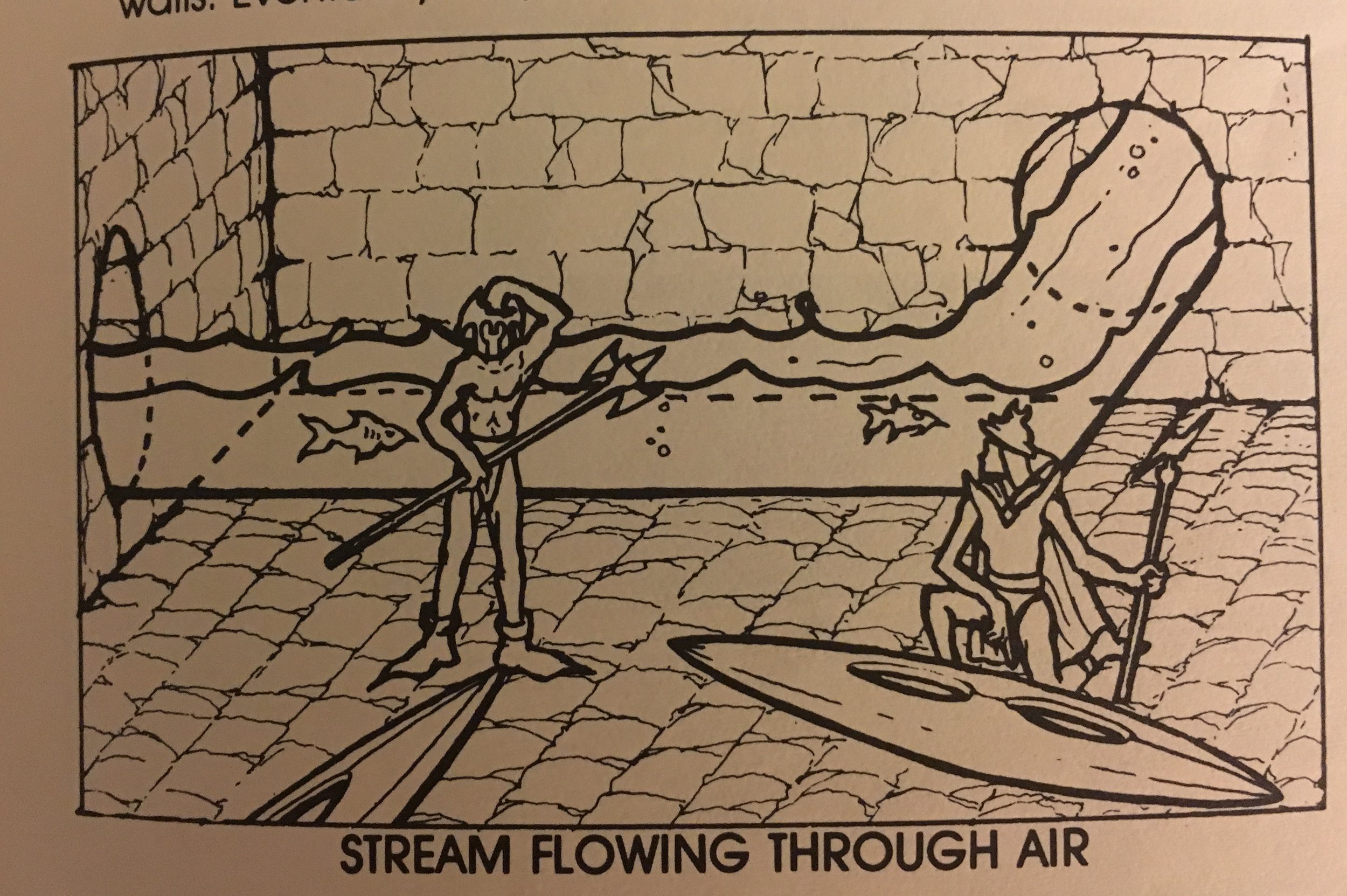
As a contrast to the prior room, this room presents a pretty obvious solution but doesn’t forbid other means of interaction. Players are likely to use the kayaks to traverse the stream, but it’s not like there is some reason waterbreathing spells or spells that freeze water would simply not work in this room. A breath of fresh air. This room is mostly a set-up for the next room (another one-two punch), but I have to give it high marks because in a very themepark-esque dungeon, this is one of the more themepark-ride-esque rooms.
Room 24. Sir Bluto’s Guardpost
★★★★★
Room Summary: On the other side of the tunnels, armed brutes are ready to murder your ass.
This is possibly one of my favorite rooms in the dungeon. First off, the gotcha aspect of this room (i.e., when the player characters kayak into this room, a team of fighters are going to try to throw nets on them, stun, trap and kill them) feels earned because, as the module explains, the fighters aren’t simply always on alert for intruders; they become alerted by disruptions in the flow of water from what the PCs do in Room 23, meaning that if the PCs figure out a way to get into Room 24 without somehow disrupting the water, they can avoid this ambush. Clever thinking rewarded! But even when players are ambushed, it feels like a sporting challenge, unlike some of the other rooms.
However, this room doesn’t stop there and applies the One More Thing Principle by making the leader of these fighters particularly interesting. Sir Bluto Sans Pite (great name) is described thusly: “a respected Knight of the Realm before his indictment in the River of Blood mass-murder case. His mysterious disappearance from prison left even the Royal Magician-Detectives baffled, and a reward of 10,000 g.p. was posted for his capture. Someone in the party is sure to recognize his one-of-a-kind face.” This is pretty short but has a ton of juice. It is the sort of subtle worldbuilding as the offhand reference to the Clone Wars in the original Star Wars was and sparks my imagination similarly. When I have used this adventure in an ongoing campaign, I have (sessions earlier) had the “River of Blood mass-murder” occur while the player-characters are in a nearby city. Some players attempt to solve it, others brush it off as an unwanted sidequest. If they do engage, they are given a chance to solve it and capture Sir Bluto themselves. Those that do engage are more intrigued when they learn their captive has escaped prison, but when they then run into him in this dungeon, it is a bit of an “oh shit” moment. Those who don’t engage at least appreciate the set-up of one of this dungeon’s goons being connected to an event described in passing earlier in the campaign. One of my groups really hated Sir Bluto (he became a recurring antagonist), and he was able to escape from them here to continue to be a thorn in the side of the PCs (that Bluto was the leader of his own rival party of adventurers, which included a warrior-artificer who created a magical suit of armor to help her walk and who was also Bluto’s paramour, an ex-prince who was executed for his illegal druidic tendencies and reincarnated by his fellow druids into the body of a young lizardfolk, and a one-eyed halfling wizard who was the former mentor of one of the players).
Room 25. Magical Secret Doors
★★☆☆☆
Room Summary: A corridor hidden by secret doors.
Like Rooms 1 and 2, this is a possible dead-end with a singular means of bypass. Either you defeated or robbed Sir Bluto and took his magic key, in which case you can find the secret doors, or Sir Bluto escaped or negotiated himself free, or you didn’t search his corpse and this is just a dead-end. This isn’t a challenge of clever thinking and in fact rewards mostly violent means of bypassing the prior room (assuming you searched the corpses, which is S.O.P.) and punishes less obvious and less violent approaches such as negotiating a peace with or sneaking past Bluto.
However, I will give it one extra star (which is still a failing grade) just because it isn’t a total dead-end for the dungeon. Room 26 is accessible even if you skip Rooms 23 and 24. It is a shame that two of the dungeon’s best rooms are totally avoidable if the party just goes left instead of right after Room 22.
Room 26. Terraced Aquarium
★★★★☆
Room Summary: A hollow inverted ziggurat where levels alternate between dry and wet but are each filled with monsters of some sort or another.
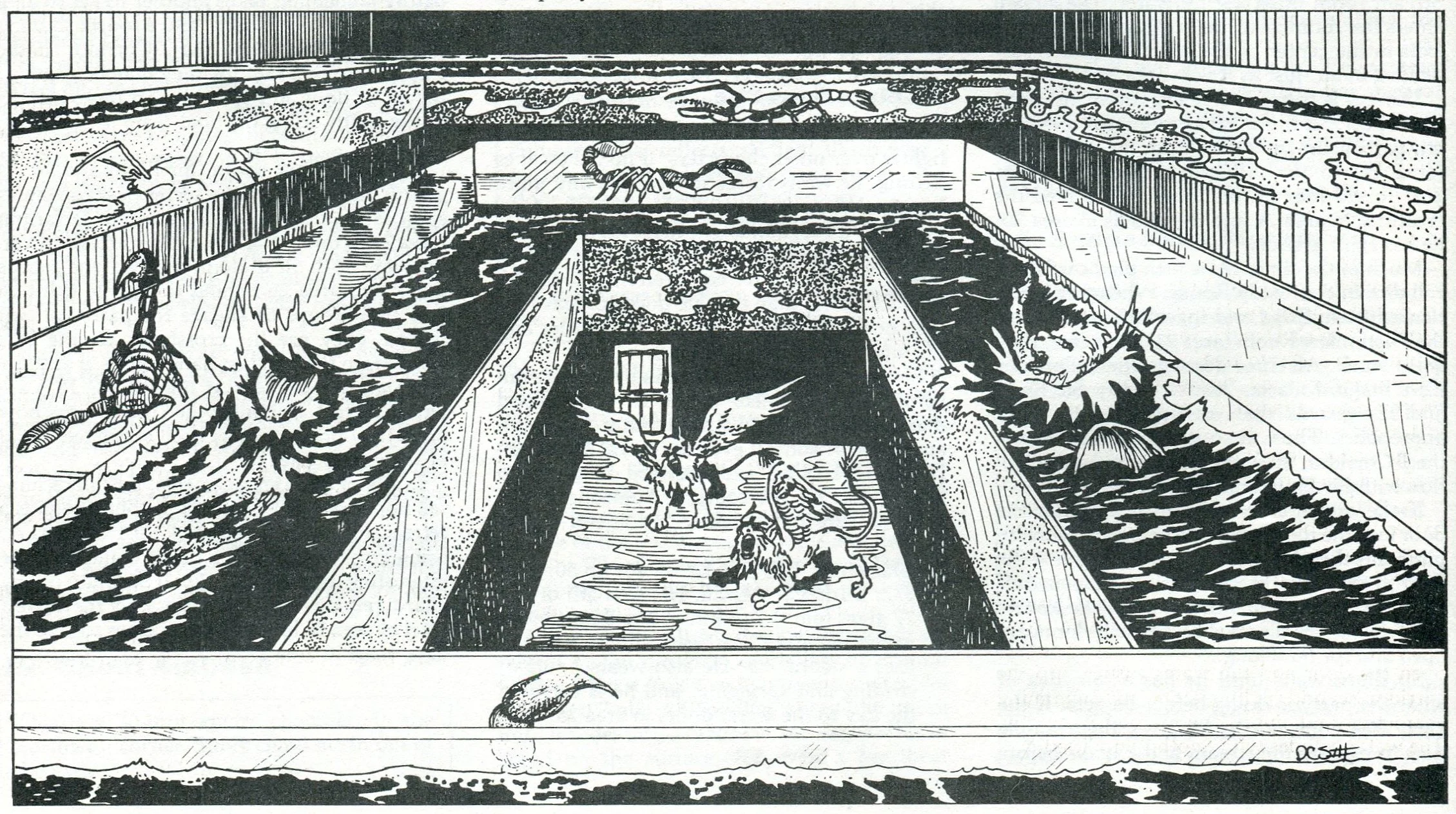
This is an iconically silly room. So many monsters that, in practice, it can be a bit of a slog if the players don’t just do their best to drown the land-creatures and leave the sea lions (based on the illustration, these are not the sea lions we know on earth) flopping in a dry tank. Players feel exceedingly clever when they can pull this off even though the room is begging you to do it, less you fight through 17 monsters in a single room. The room has a lot of guardrails (specifically walls of force) to ensure you can’t use the water to also soak away the contents of Room 27, which feels a bit like overkill, but I am fine with it because the solution here is so obvious and because even if the party does fight through the monsters the honest way, if they hastily open the safe at the bottom, it will trigger a vibration device that busts all the walls and floods the bottom either way. It does take forever (20 full turns) for the water to finally drain out, which might be sacrificing gameplay for a boring type of realism. Keraptis should have installed a more efficient drainage system. I am grading this room more favorably than it perhaps deserves because the image of this absolute menagerie of monsters is the type of weird shit I like to see in my funhouse dungeons.
Also, how did Keraptis fill these levels with water anyway? Should I be imagining an evil arch-mage with a little hose like he’s filling an inflatable backyard swimming pool for a child’s birthday party? Well, I do.
Room 27. Luxurious Prison
★★★★☆
Room Summary: A ogre mage posing as a halfling who guards treasure in a luxurious apartment.
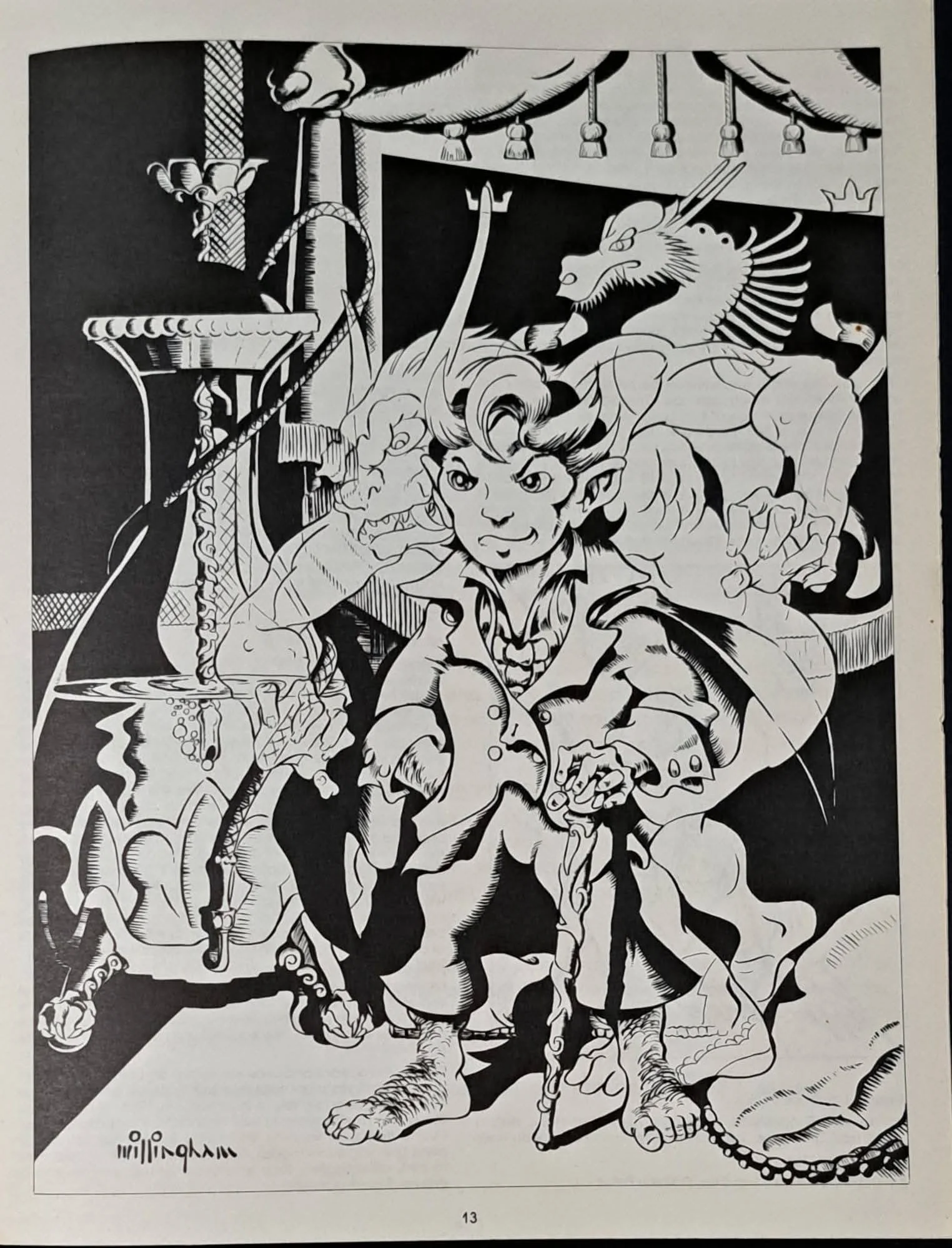
Qesnef, the ogre mage who disguises himself as a doughy halfling, lacks the charm of a Sir Bluto Sans Pite. And certainly lacks the fun name. Qesnef is a bottom-of-the-barrel fantasy name. There isn’t quite enough detail to easily roleplay him when he is in disguise, only that the halfling is “perhaps one who has been trapped by the evil wizard”. I usually do the halfling bit just long enough to get their guard down. Qesnef invites them to sit and puff on his hookah, and he acts as a chill guy, perhaps a new follower for the party. Then I let him begin to show off the treasures in his room, ending, of course, with Blackrazor. The module doesn’t say that Qesnef will use Blackrazor, but why wouldn’t he? It is the coolest item in a module with a few very cool items.
Blackrazor is, admittedly, a ripoff of Michael Moorcock’s Stormbringer from the Elric series of fantasy novels. But that doesn’t make it less cool. “Blackrazor” is also a much better sword name; one of the best, in fact. It is a black sword that “shines like a piece of the night sky filled with stars” and it sucks souls (except undead, where it backfires on the user, but the module says to “keep this little drawback a secret”, which is good advice), in addition to lots of other powers. Qesnef alone is already quite the challenge but with Blackrazor, it is a potential TPK and at the very least another memorable fight in this dungeon. Overall, the sheer badassery of the sword makes up for many of my qualms I would otherwise have with Qesnef’s interior decorating.
The only complaint is that the room is not particularly cinematic for this otherwise potentially catastrophic fight. It’s basically just Qesnef’s mancave. I usually have the fight begin here but use Qesnef’s movement to lead them back into Room 26, which has much better battle-ambiance (an entire post could and should be written on this concept) whether the PCs left it in its original state of flooded it and waited for the water to drain out.

Non-Room. The End Note
★★☆☆☆
Non-Room Summary: A force wall returns and Kerpatis sends his efreet goons after the party.
This is a sort of epilogue for successful parties that obtained “two or even three of the magical weapons”. They get stopped back at Room 2, listen to a speech over the intercom from Keraptis, and then get waylaid by two efreet. This entire encounter seems like such an afterthought that the module suggests “this whole episode can be omitted if the party has already taken too much damage” and, on the contrary, if they had too easy of a go through the dungeon, make it four efreet (the efreet, by the way, are named Nix and Nox and Box and Cox, which makes me assume Lawrence Schick must be a fan of the Dr. Seuss book, Fox in Socks). I don’t like this method of encounter design, Sam-I-Am. Either the Efreet are always encountered if they’re triggered or they’re not. And if the number is variable, it should be based on how easy of a time the party had. I am not the blorbiest POSR blogger in the game, but this violates my sense of sportsmanship. If the party had an easy time in the rest of the dungeon, they should be rewarded by being at fuller strength for this fight rather than being punished by extra monsters. Why punish good play? Also, Room 2 is a terrible place for this encounter to occur. It is a narrow hallway with little in the way for a dynamic environment for a fight. But the dungeon doesn’t give much of a choice since this narrow path is the only area the player-characters will go on their return regardless of which path they are returning from.
The ending advice gives credence to the rumor (basically confirmed by Schick himself, saying in an interview that “Gary decided to publish it as a module without changing a line”) that this dungeon was sent in as part of Schick’s job application and then just essentially published “as is”. For the Indoctrination Center, which is accessible to the players outside of the end note, the following advice is given: “you will just have to play it by ear. It’s not too difficult – use your imagination and make it up as you go.” Draw the rest of the fucking owl. I don’t mind this too much, given all the owl sketches the module already provides. At some point we all must leave the nest and draw our own owls.
Average Rating of Rooms: 3.43 out of 5 Stars.
However, the dungeon is slightly less than the sum of its parts because of its total lack of Jaquaysing. There are very few choices in navigation other than “do we go forward, or do we go backwards”, with a single real choice of path near the beginning where you pick one of three routes and just keep going down the chosen route until you hit its dead end. This also requires lots of backtracking through the dungeon and no alternative routing. It’s mostly tedious backtracking (with the exception of Room 7) that most referees will simply handwave. For removing the typical navigational delights of a dungeon crawl, I must deduct a full one-star from the dungeon as a whole, leading to the most scientifically accurate assessment of White Plume Mountain being 2.43 out of 5 Stars. A perfectly cromulent dungeon! This score probably underassesses it because we remember dungeons more for all their cool ideas (17 rooms were 4 or 5 stars!) rather than all the ideas that sort of sucked (9 rooms were 1 or 2 stars) which we tend to move past quickly to get to the good stuff.